
%20(53).png)
Generative AI has moved faster from research labs to enterprise production than almost any technology before it. The economic case is no longer theoretical: McKinsey projects generative AI could add between $2.6 trillion and $4.4 trillion annually to the global economy, representing a 15-40% increase on top of value from other AI technologies.1
This article covers what generative AI is, how it differs from other AI, and the concrete ways it's changing how enterprises across industries operate.
TL;DR: Generative AI produces original content (text, images, code) by learning from large datasets, making it useful across nearly every enterprise function. McKinsey projects it could add $2.6-4.4 trillion annually to the global economy. It's already reshaping business operations in marketing, software development, customer service, retail, and HR. TextCortex lets enterprises deploy generative AI on their own company data securely, with ISO 27001, SOC 2, and EU AI Act compliance.
What is Generative AI?
Generative AI represents a significant advancement in artificial intelligence, capable of creating original content across various mediums including text, images, audio, and computer code. These systems, powered by deep learning algorithms and neural networks, learn patterns from vast datasets to produce human-like outputs.
From crafting marketing copy to generating realistic images, or assisting in drug discovery, generative AI is changing how organizations work and innovate across nearly every sector.
How Generative AI Differs from Other AI
Traditional AI excels at pattern recognition, classification, and prediction based on predefined rules or learned patterns. A conventional AI model accurately identifies objects in an image; a generative AI creates an entirely new image from a text description. A traditional system summarizes written text; a generative AI composes original articles or engages in multi-turn conversation.
This creative capacity is what sets generative AI apart. It doesn't just assist with decisions, it generates new outputs, enabling enterprises to produce content, code, and analysis at a scale that wasn't previously possible.
The Economic Impact of Generative AI
The economic impact of generative AI is projected to be substantial across industries. According to a McKinsey report, generative AI could potentially add between $2.6 trillion and $4.4 trillion annually to the global economy, a significant increase of 15-40% on top of the value that other AI technologies are expected to create.
The adoption of generative AI is expected to have far-reaching effects on productivity. It could enable labor productivity growth of 0.1 to 0.6% annually through 2040, depending on adoption rates and how effectively worker time is redeployed. The generative AI market itself is projected to grow from $40 billion in 2022 to $1.3 trillion over the next 10 years.
Generative AI Across Industries
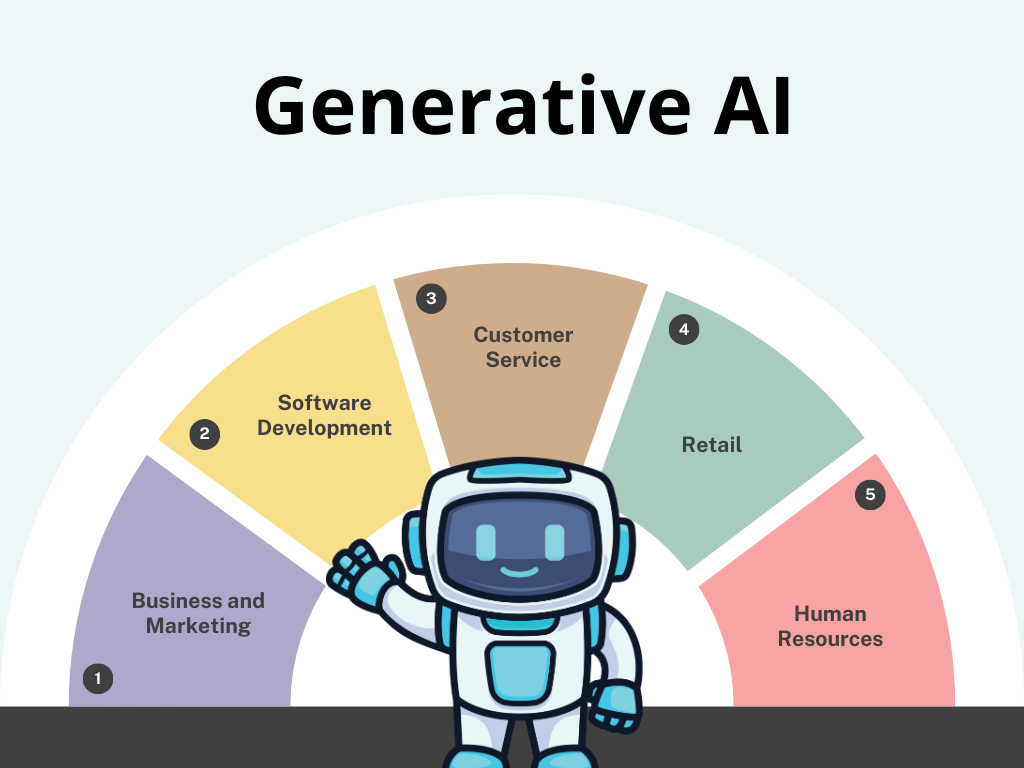
Business and Marketing: Personalizing Customer Engagement
Generative AI enables hyper-personalization at scale. By analyzing customer data, AI generates tailored marketing messages, product recommendations, and entire email campaigns that align with individual preferences and behaviors.
In content marketing, generative AI produces blog posts, social media content, and product descriptions aligned with brand voice while addressing specific customer pain points. This level of personalization improves conversion rates and customer loyalty at a fraction of the manual effort.
Software Development: Accelerating Code Creation
Generative AI tools write, complete, and debug code. Platforms like GitHub Copilot suggest entire functions or code blocks based on natural language descriptions or partial code, allowing developers to focus on architecture and problem-solving rather than boilerplate.
Generative AI also assists in code refactoring, automatically suggesting optimizations and identifying potential bugs. The result is faster development cycles, reduced errors, and more efficient use of developer resources.
Customer Service: Elevating Support Interactions
AI-powered chatbots and virtual assistants now engage in context-aware, natural conversations, understanding complex queries and providing detailed, accurate responses by accessing vast knowledge bases instantly. They handle multiple interactions simultaneously, reducing wait times and improving service efficiency.
Generative AI also assists human agents by suggesting responses, summarizing customer issues, and predicting potential escalations, resulting in faster resolution times and more streamlined support operations.
Retail: Transforming Shopping Experiences
In the retail sector, generative AI creates more immersive and personalized shopping experiences. Virtual try-on technologies let customers see how products would look without physical sampling. AI generates personalized product recommendations based on browsing history, purchase behavior, and current trends.
Generative AI also enables dynamic pricing strategies, adjusting prices in real time based on demand, inventory, and competitor pricing, blurring the lines between online and offline commerce.
Human Resources: Recruiting and Training
In talent acquisition, AI generates job descriptions that are both inclusive and compelling. It analyzes resumes and cover letters, generating insights about candidate suitability. For employee development, generative AI creates personalized learning paths, generating custom content that addresses each employee's specific skill gaps and preferred learning style.
These applications streamline HR processes and contribute to more objective, efficient talent management across the organization.
TextCortex for Enterprise AI Deployment
TextCortex is an EU-based enterprise AI infrastructure platform that puts all of these generative AI capabilities within reach of your organization, built on your own company data rather than generic public models.
TextCortex offers multi-model access (GPT-4o, Claude, Gemini, and others), knowledge base integration with SharePoint, Google Drive, OneDrive, and Notion, and workflow automation through Flows. It's available as a web application and browser extension integrated with 30,000+ apps and websites.
Results from b2venture, an investment firm with over €800M AUM:
- 7x AI usage growth across the investment team
- 70% team adoption achieved
- 5-10 hours saved per investment opportunity assessed
- 10+ specialized AI agents deployed across distinct research and workflow functions
TextCortex is ISO 27001 certified, SOC 2 certified, fully GDPR and EU AI Act compliant, serving Fortune 500 and DAX 40 customers worldwide. Sign up and experience the power of enterprise AI built on your own data.
Frequently Asked Questions
What is generative AI?
Generative AI is a class of artificial intelligence that creates original content (text, images, code, audio) by learning patterns from large datasets. Unlike traditional AI, which classifies or predicts based on existing patterns, generative AI produces entirely new outputs, making it useful for content creation, code generation, data analysis, and conversational applications.
How is generative AI different from traditional AI?
Traditional AI identifies patterns and makes predictions based on predefined rules or learned data. Generative AI goes further by creating new content. A traditional AI recognizes whether an image contains a cat; a generative AI can create a new image of a cat from a text description. This generative capability enables enterprises to automate creative and knowledge work at scale.
What is the economic impact of generative AI?
McKinsey projects generative AI could add $2.6-4.4 trillion annually to the global economy, representing a 15-40% increase on top of value from other AI technologies. The generative AI market is projected to grow from $40 billion in 2022 to $1.3 trillion by 2032. Enterprise adoption has accelerated significantly, with 78% of organizations now using AI in at least one business function as of 2025.
Which industries benefit most from generative AI?
McKinsey identifies marketing and sales, software development, and customer operations as the highest-impact functions for generative AI deployment, where the technology can automate or augment the most time-intensive knowledge work. Retail, HR, and procurement are also seeing significant measurable returns from targeted deployments.
How do enterprises deploy generative AI securely?
Secure enterprise deployment requires a platform that runs on your own data (not public models), enforces role-based access controls, and meets applicable compliance standards (ISO 27001, SOC 2, GDPR). TextCortex is purpose-built for this: it integrates with your existing data infrastructure and never uses your company data to train public models.
What are the most common enterprise generative AI use cases?
The most common use cases are knowledge management and retrieval, customer support automation, content generation at scale, personalized sales and marketing outreach, code generation and review, and employee onboarding. McKinsey's 2025 data shows enterprises are deploying AI across an average of 3 business functions simultaneously.
1 McKinsey Global Institute. "The Economic Potential of Generative AI: The Next Productivity Frontier." 2023. mckinsey.com
.png)
.png)
.png)