%20(13).png)
Project management is being changed significantly by AI agents: intelligent, autonomous software that handles planning, risk assessment, reporting, and team coordination with minimal human supervision. These systems are becoming standard in IT departments, construction firms, and project management offices worldwide.
This article covers what AI agents do in project management, the benefits they deliver, and practical use cases across planning, risk, collaboration, and stakeholder management.
TL;DR: AI agents in project management are software systems that use AI and machine learning to perform project tasks autonomously: planning and scheduling, risk prediction, reporting, and team communication. HBR projects 80% of project management tasks will be run by AI. Key benefits include automation of routine tasks, improved forecasting, enhanced team collaboration, and better stakeholder communication. TextCortex helps project teams deploy AI agents on their own data for knowledge retrieval, report generation, and workflow automation.
What Are AI Agents in Project Management?
AI agents in project management are sophisticated software systems that use artificial intelligence and machine learning to perform various project management tasks autonomously. These agents analyze project data, make decisions, and take actions to achieve specific goals within project environments. Unlike traditional project management software, AI agents learn from experience, adapt to new situations, and improve performance over time.
Types of AI Agents Used in Project Management
- Planning and Scheduling Agents: Specialize in creating and optimizing project schedules, resource allocation, and task dependencies.
- Risk Assessment Agents: Analyze project data to predict and mitigate potential problems before they occur.
- Reporting and Analytics Agents: Generate insightful project reports, dashboards, and analytics to keep stakeholders informed.
- Communication Agents: Manage communications, automate notifications, and summarize meetings to facilitate team collaboration.
Key Areas of AI Agents in Project Management
AI agents are being deployed across various aspects of project management, enabling new approaches to processes that previously required significant manual effort.
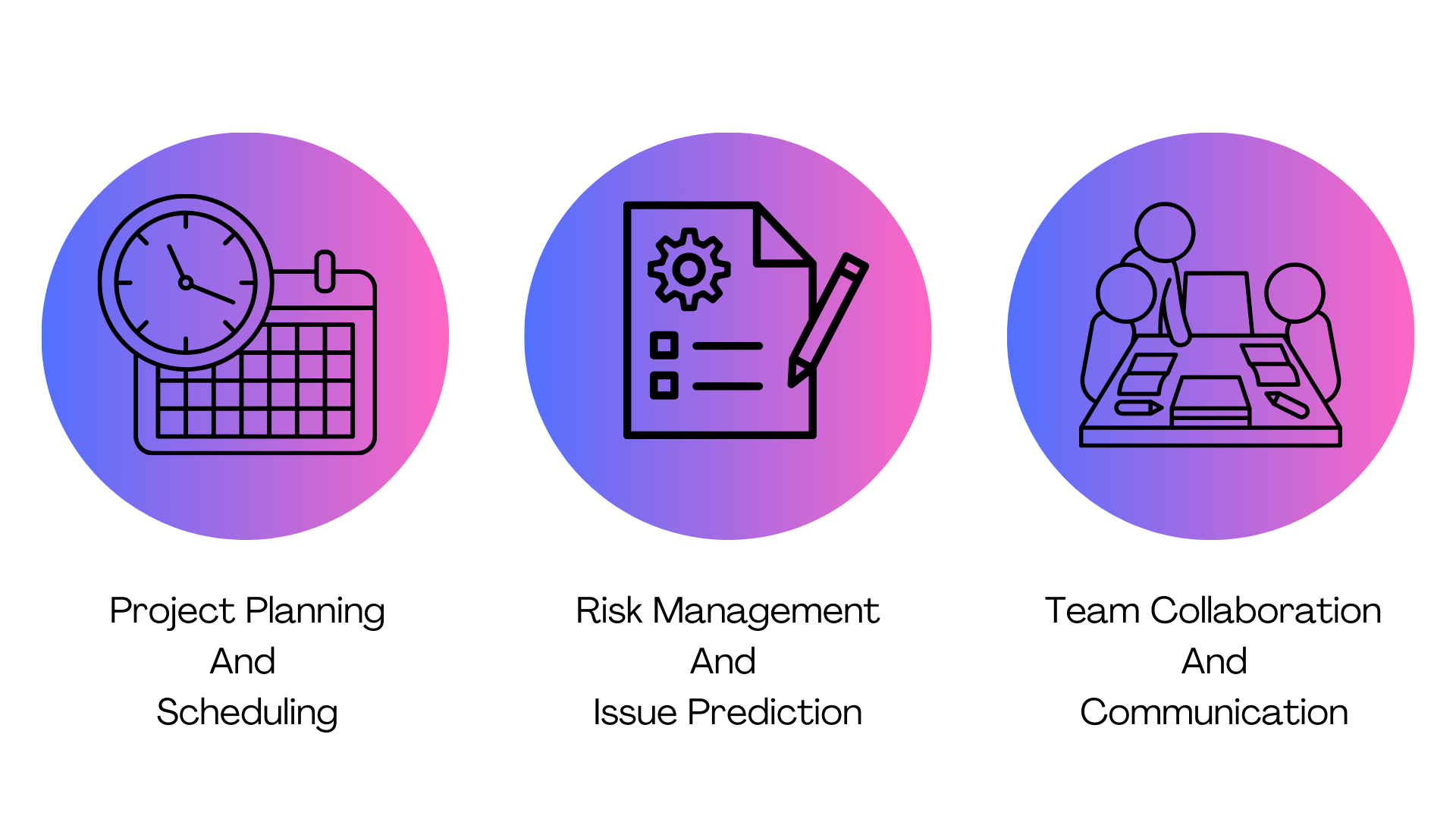
Project Planning and Scheduling
AI agents have changed project planning and scheduling. By analyzing historical project data, resource availability, and task dependencies, these agents generate optimized project schedules. They can:
- Create detailed work breakdown structures
- Estimate task durations with greater accuracy
- Identify potential bottlenecks and resource conflicts
- Assist in scenario planning and what-if analysis
The ability of AI agents to process large amounts of data and identify complex patterns allows for more dynamic and responsive project planning. This enables project managers to make more informed decisions and adjust strategies in real time based on changing conditions.
Risk Management and Issue Prediction
In project risk management, AI agents identify and mitigate potential issues before they escalate. These agents:
- Monitor project progress in real time to identify deviations from the plan
- Analyze historical project data to predict common pitfalls
- Use machine learning to adapt to new risk patterns
- Automatically flag high-risk areas for human review
By using AI agents for risk management, project teams significantly reduce the likelihood of project failures. The continuous learning capabilities of these agents allow them to stay ahead of evolving project challenges.
Team Collaboration and Communication
AI agents have improved team collaboration in project management by providing intelligent, context-aware support. These agents:
- Handle routine team inquiries and status updates through chatbots
- Provide personalized task recommendations based on individual team member data
- Offer meeting summaries and action item tracking
- Assist in onboarding new team members and knowledge transfer
This leads to increased team productivity and better project outcomes by giving each team member quick, accurate, and relevant assistance without manual coordination overhead.
Benefits and Use Cases of AI Agents in Project Management
Automating Routine Project Management Tasks
AI agents handle day-to-day project operations at scale. By automating routine tasks, these agents increase efficiency while reducing human error and operational overhead. In status reporting and time tracking, AI agents collect data, generate reports, and update project management software without human intervention, ensuring consistency and accuracy across multiple projects.
HBR estimates that 80% of project management tasks will be run by AI, powered by big data, machine learning, and natural language processing.
Enhancing Project Analysis and Decision-Making
AI agents process and analyze vast amounts of project data quickly, improving forecasting, enabling accurate predictive modeling, and supporting complex scenario analysis. Project managers get insights based on the full data picture rather than a manually assembled subset, leading to better-informed strategic decisions.
Improving Stakeholder Management and Communication
AI agents enhance the project manager's ability to manage stakeholders through real-time project status updates and stakeholder-specific reporting. They generate reports tailored to different audiences (executive summaries, technical details, budget tracking) without requiring the project manager to produce each version manually.
AI agents are not just automating existing processes; they're enabling new approaches to project operations, analysis, and stakeholder management. They handle routine work so project professionals can focus on higher-value activities: relationships, strategic planning, and decisions that require human judgment.
TextCortex for Project Management Teams
TextCortex is an EU-based enterprise AI platform that helps project teams deploy AI agents on their own project data, documentation, and knowledge bases. It integrates with your existing project management systems (SharePoint, Google Drive, Notion, Confluence) and makes project knowledge queryable in natural language, ensuring your analyses always incorporate the most current information.
TextCortex's knowledge base feature becomes a central hub for your team's collective project wisdom: meeting notes, risk registers, status updates, and lessons learned, all queryable in plain language. Teams can retrieve past project data, generate progress reports, and onboard new team members without manual document searches.
See results from MAHLE, a global automotive supplier and DAX company deploying TextCortex for enterprise knowledge and project management:
- 65% AI adoption within the first month of deployment
- 5+ hours per week saved per employee through faster knowledge retrieval and documentation
- Agents deployed directly on SharePoint, making project documentation instantly queryable via natural language
TextCortex is ISO 27001 certified, SOC 2 certified, fully GDPR and EU AI Act compliant, serving Fortune 500 and DAX 40 customers worldwide. Sign up and start deploying AI agents on your project data.
Frequently Asked Questions
What are AI agents in project management?
AI agents in project management are software systems that use AI and machine learning to perform project tasks autonomously: generating schedules, predicting risks, creating reports, managing communications, and tracking progress. Unlike traditional project management software, they learn from experience and adapt over time rather than following fixed rules.
How do AI agents help with project planning and scheduling?
AI agents analyze historical project data, resource availability, and task dependencies to generate optimized schedules. They estimate task durations based on past performance, identify bottlenecks and resource conflicts before they cause delays, and support scenario planning and what-if analysis. Project managers get a more accurate baseline and real-time adjustments as conditions change.
How do AI agents improve project risk management?
AI agents monitor project progress continuously against the plan, flag deviations before they become significant, analyze historical data to identify patterns that precede common project failures, and adapt their risk models as they learn from new data. This shifts risk management from reactive (responding to problems) to proactive (preventing them).
What percentage of project management tasks will AI handle?
HBR projects that 80% of project management tasks will be run by AI, powered by big data, machine learning, and natural language processing. The tasks most likely to be automated first are status reporting, time tracking, resource allocation, meeting scheduling, and routine stakeholder communications, all of which are high-volume and follow predictable patterns.
How do AI agents help with stakeholder communication?
AI agents generate stakeholder-specific reports automatically: executive summaries for leadership, technical detail for engineers, budget summaries for finance. They provide real-time project status updates and flag issues that require escalation without waiting for scheduled reporting cycles. This reduces the overhead of manual report production while improving stakeholder visibility.
What project management tools does TextCortex integrate with?
TextCortex integrates with SharePoint, Google Drive, Microsoft OneDrive, Notion, and Confluence for document and knowledge integration. It also connects with Make.com and Zapier for workflow automation, meaning project workflows can be built across the tools your team already uses without rebuilding your infrastructure.
.png)
.png)
.png)