
%20(43).png)
Generative AI began to be widely adopted for professional purposes after OpenAI released ChatGPT in late 2022. It can help individuals with daily tasks and reduce employee workload at scale. And the development of generative AI technology offers distinct advantages not just for individuals but for entire organizations.
Although the most successful generative AI models today were developed to generate text, images, and code, research and fine-tuning in the field of AI have created effective uses for enterprises and teams across every major function.
In this article, we will explore what generative AI is and the advantages it offers for enterprises.
TL;DR: Generative AI helps enterprises cut costs, accelerate output, automate repetitive workflows, and manage knowledge collaboratively. McKinsey's 2025 research shows 78% of organizations now use AI in at least one business function. Key advantages include automation, collaborative knowledge management, enhanced creativity, time efficiency, and cost-effectiveness, each with measurable ROI when deployed on the right infrastructure.
What is Generative AI?
Generative AI is a program that uses technologies such as natural language processing, deep learning, machine learning, and neural networks. Generative AI models are trained with large amounts of data to generate output and understand users' input.
A generative AI model produces higher quality outputs with whatever type of data it is trained on. For example, if an AI tool is trained with data containing written content such as emails, blog posts, and product descriptions, it will produce that type of written content more successfully. Each generative AI model analyses its trained data with its parameters and generates the output with the probability closest to the user's intent.
What is AI for Enterprise?
Since each generative AI model is trained to perform different tasks, not every AI model is designed for enterprises. The concept of enterprise AI represents tools with features designed to meet the needs of a business, specifically around security, governance, team collaboration, and integration with proprietary data.
For example, AI tools with knowledge-oriented features such as TextCortex allow you to integrate your enterprise data and generate output using that data.
You can use this feature to serve as an AI-powered resource for new people working in your enterprise and get them familiar with your work ethic and tasks faster, boosting the onboarding process. AI designed for enterprises offers features not only for individual tasks but also for team tasks and organizational governance.
Advantages of Generative AI for Enterprises
Generative AI for enterprises offers substantial advantages for organizations that deploy it with a clear strategy. Let's take a closer look at the advantages of generative AI for enterprises.
Automation
One of the biggest functions of generative AI for enterprise tools is that it greatly reduces workload by automating repetitive and routine tasks. Instead of manually writing responses to hundreds of emails and tickets every day, you can automate this task with generative AI tools.
See how Klarna demonstrated this in customer support operations:
- The AI assistant handled 2.3 million conversations, two-thirds of Klarna's customer service chats
- It is doing the equivalent work of 700 full-time agents
- It is on par with human agents in customer satisfaction scores
- More accurate in errand resolution, leading to a 25% drop in repeat inquiries
- Customers resolve their errands in less than 2 minutes, compared to 11 minutes previously
- It's available in 23 markets, 24/7 and communicates in more than 35 languages
Collaborative Knowledge Management
Collaborative knowledge management is enabled by a generative AI system that can deliver actionable insights out of your data, increasing employee productivity and helping teams manage operational tasks more effectively.
See results from b2venture, an investment firm with over €800M AUM that deployed TextCortex across their team:
- 7x AI usage growth within the investment team after deployment
- 70% team adoption across the organization
- 5-10 hours saved per investment opportunity assessed
- 10+ specialized agents deployed, each handling a distinct research or workflow function
Enhancing Creativity
Generative AI tools help teams generate fresh content angles, explore different writing styles, and produce creative variations at speed. Equipped with training across numerous languages and content types, these tools can offer novel approaches on any subject matter, useful for marketing teams, product writers, and anyone producing customer-facing content regularly.
Another area where generative AI enhances creativity is graphic design and image generation. Since generative AI is trained on thousands of images spanning different artistic styles and genres, it can combine them to create new, unique visuals, from product design to brand assets.
Time Efficiency
One of generative AI's clearest advantages for enterprises is output generation speed. Content produced with generative AI is consistently faster than manual work, a task that takes an employee an hour can often be completed in minutes.
For example, while writing an email manually takes 30 to 60 minutes, generating an email with generative AI tools takes less than a minute. The only remaining work is a quick review pass. At scale, this compounds into significant hours recovered across teams.
Cost Effective Solution
Generative AI tools complete tasks faster and at a fraction of the cost relative to the output they produce. Although each tool's pricing policy varies, generative AI tools generally offer enterprise access at a cost-effective price relative to equivalent manual effort. You can direct your remaining budget to more critical aspects of your enterprise, strategy, relationships, and growth.
Atares achieved 20 hours per week saved in operational time after deploying TextCortex. See the full case study here.
TextCortex, Enterprise AI Infrastructure
TextCortex is an EU-based enterprise AI infrastructure platform that lets organizations deploy and govern AI agents on their own company data, securely. It provides multi-model access from one platform: GPT-4o, Claude, Gemini, and others, so teams aren't locked into a single model vendor.
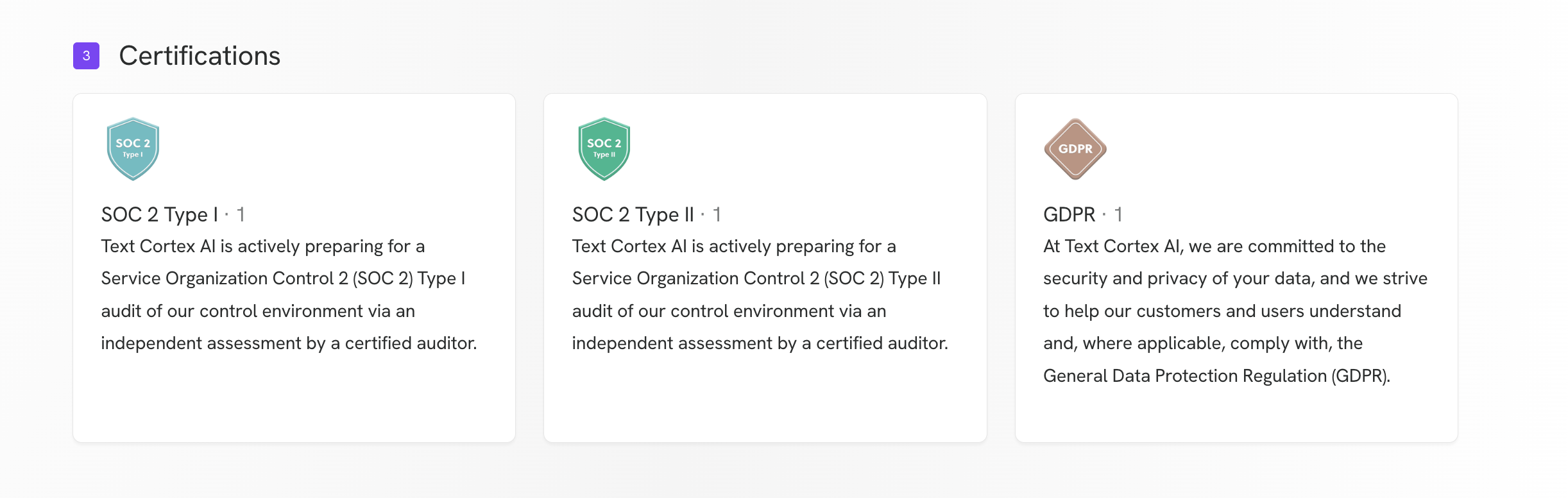
TextCortex holds ISO 27001, SOC 2, GDPR, and EU AI Act compliance, and serves Fortune 500 and DAX 40 customers worldwide. The onboarding includes a 3-month AI training program: 4 workshops, team certification, and a dedicated account manager to drive adoption from day one.
Every team (sales, HR, legal, customer support, product) gets access to a shared AI infrastructure built on your proprietary data. Employees query it in natural language; the platform surfaces the right information without exposing sensitive data beyond authorized roles.
Frequently Asked Questions
What are the main advantages of generative AI for enterprises?
The main advantages are automation of repetitive tasks, collaborative knowledge management, enhanced creativity in content production, speed of output, and cost-effectiveness relative to manual effort. McKinsey's research shows organizations using AI across multiple functions consistently report both cost reductions and revenue improvements.
How does generative AI save time for enterprise teams?
Generative AI accelerates tasks like email drafting, report writing, research summarization, and content creation from hours to minutes. TextCortex customer Atares reports saving 20 hours per week in operational time after deployment, and that's a conservative baseline for teams that automate multiple routine workflows.
Can generative AI reduce enterprise costs?
Yes, and the ROI is measurable. b2venture, an investment firm with over €800M AUM, achieved 7x AI usage growth and 70% team adoption with TextCortex, translating to 5-10 hours saved per investment opportunity assessed. For enterprises, those savings compound quickly across dozens of analysts and hundreds of decisions.
What makes AI different for enterprises versus individual users?
Enterprise AI tools integrate with proprietary company data, enforce access controls, and operate within governance frameworks like GDPR and SOC 2. They're designed for multi-user deployment, team collaboration, and organization-wide policy management, not just individual productivity tasks.
Is generative AI secure enough for enterprise use?
It depends on the platform. Enterprise-grade platforms like TextCortex are ISO 27001 and SOC 2 certified, fully GDPR compliant, and EU AI Act aligned. Your company data stays within your controlled infrastructure and never trains public models. Always verify compliance certifications before deploying AI on sensitive enterprise data.
How quickly do enterprises see results from generative AI adoption?
Enterprise AI deployments typically move from pilot to meaningful impact in 7 to 12 months. TextCortex customers see faster activation because the onboarding program is structured: 4 workshops, team certification, and a dedicated account manager handling adoption from the start.
1 McKinsey & Company. "The State of AI: How Organizations Are Rewiring to Capture Value." 2025. mckinsey.com
.png)
.png)
.png)