
.png)
When considering the implementation of AI tools in your organisation, you're faced with two options: retrieval-augmented generation (RAG) and large language model (LLM) fine-tuning. While both options have their advantages and disadvantages, the key is to choose the one that best meets your organisation's needs. If you're struggling to decide between retrieval-augmented generation (RAG) and large language model fine-tuning and are looking for answers, we've got you covered!
In this article, we'll explore the differences between retrieval-augmented generation (RAG) and LLM fine-tuning.
Ready?
Let's dive in!
TL; DR
- RAG enables large language models to generate output using specific knowledge bases.
- LLM fine-tuning allows you to manipulate and customize the training data of large language models.
- RAG and LLM fine-tuning have different use cases and benefits.
- You can integrate both RAG and LLM fine-tuning methods simultaneously into your company.
- If you're looking for a company AI assistant that offers both RAG and LLM fine-tuning, TextCortex is designed for you.
What is Retrieval-Augmented Generation (RAG)?
Retrieval-augmented generation (RAG) systems allow large language models to generate output using specific databases rather than relying on existing data or internet data. For example, a typical LLM uses training data and, if available, internet data to generate output. On the other hand, RAG-powered large language models use user-specified specific data sources to generate output.
RAG Use Cases
By implementing retrieval-augmented generation (RAG) systems into the large language models you already use in your company, you can begin using them in various areas. For example, you can use RAG-powered AI chatbots to help your employees quickly access the information or documents they're looking for. Another use case is improving customer satisfaction by integrating RAG systems into a customer support AI chatbot. Some of the most popular RAG use cases include:
- Information Search
- Customer Support Chatbot
- Finance Analysis
- Summarization and Classification
- Analytics
- Knowledge Management
Benefits of RAG
AI chatbots powered by retrieval-augmented generation (RAG) offer numerous benefits for both employees and customers. Employees can increase productivity by automating repetitive tasks with RAG-powered AI chatbots. Furthermore, employees can save time and increase collaboration by facilitating cross-departmental knowledge sharing with RAG-powered AI chatbots. RAG-powered customer support chatbots can quickly generate accurate and correct responses to customer questions, increasing customer loyalty and satisfaction.
What is LLM Fine-Tuning?
Large language model fine-tuning involves training a basic model with domain-specific datasets and building a customized LLM. The goal of LLM fine-tuning is to ensure the model understands the company's nuances, context, and language patterns and generates output based on this information. If your company data is static and you'll be using the same data for a long time, LLM fine-tuning is a good option.
LLM Fine-Tuning Use Cases
LLM fine-tuning is an effective solution in areas where static data is used and data remains constant or rarely changes, such as law enforcement. For example, if you have an organization with proven and stable datasets, such as healthcare, you can use LLM fine-tuning to answer customer queries. Use cases where LLM fine-tuning is effective include:
- Healthcare
- Finance
- Legal
- Personal Trainer
- Language Learning Partner
Benefits of LLM Fine-Tuning
Fine-tuned large language models use specific data sources to inform their output. The biggest benefit of this is that companies with static data can always provide accurate and precise information to their employees and customers. Fine-tuned AI chatbots ensure consistency in their output, increasing reliability. Fine-tuned LLMs are also useful for tasks such as summarization, classification, error detection, and Q&A.
RAG vs LLM Fine-Tuning: Comparison
While retrieval-augmented generation (RAG) and LLM fine-tuning may seem similar at first glance in terms of function and benefits, they have distinct differences and advantages. Let's discover the differences between RAG and LLM together!
Data Type
LLM fine-tuning uses static data and is not suitable for tasks requiring constant information updates. While LLM fine-tuning allows users to continuously generate output with specific data, RAG-powered LLMs provide outputs that utilize changing and updated data in their knowledge bases. If your organization has static data, LLM fine-tuning may be sufficient, while if your organization has constantly changing tasks like marketing and SEO, RAG is a better option.
Setup Process
Implementing retrieval-augmented generation (RAG) systems on large language models doesn't require advanced coding skills or extensive time. On the other hand, fine-tuning an LLM requires machine learning knowledge and the time it takes to fine-tune the LLM.
Diversity of Use
You can use retrieval-augmented generation (RAG)-powered large language models to automate any task related to your company or to help you complete tasks. RAG-powered LLMs support you in any company project and can generate output using all company data. On the other hand, fine-tuned LLMs offer limited use, using only the specific datasets they were trained on.
Scalability
RAG systems offer flexible and fast updates because they continuously analyze knowledge bases and generate output. However, once you've fine-tuned an LLM, you'll need to fine-tune it again if you want to add new information. Depending on how complex the information you're adding, fine-tuning an LLM can be a challenging and lengthy process.
Core Use Cases
Because retrieval-augmented generation (RAG) is compatible with constantly changing data, it's effective for tasks and departments with high data input and output. You can use RAG-powered LLMs for tasks like knowledge management, chatbots, real-time answers, and information search.
On the other hand, LLM fine-tuning is more suitable for tasks involving static data. You can use the LLM fine-tuning method for tasks like classification, summarization, and structured output generation.
Can You Leverage Both RAG and LLM Fine-Tuning?
Yes, you can combine both RAG and LLM fine-tuning in your business. By fine-tuning the large language model you'll use in your company, you can ensure it has a solid foundation and fully understands your company policies. Then, by implementing RAG in your company LLM, you can generate output with real-time data and automate your tasks. Many company AI assistants, such as TextCortex, aim to maximize efficiency for organizations by offering both fine-tuned LLM and powerful agentic RAG.
TextCortex: Leverage RAG and LLM Fine-Tuning
TextCortex offers enterprise users both a fine-tuned LLM experience and an agentic RAG experience. Unlock all of TextCortex's features by integrating them into your organization. Furthermore, TextCortex integrates with over 30,000 applications and websites, so it can continue to support you anytime, anywhere.
Let's discover the features and tools offered by TextCortex.
TextCortex Seamless Integrations
TextCortex offers integrations with 30,000+ websites and apps including Gmail, Google Docs, Pages, Notion, and Slack to be with its users anytime, anywhere. With TextCortex, you can continue working without having to switch tabs, thus saving time and energy. In other words, TextCortex aims to provide you with the best experience by adapting to your working style, pace, and needs.
TextCortex Knowledge Bases
TextCortex offers knowledge bases for individual and team users where they can store all their internal data and use it with various AI features. Using our knowledge bases, you can organize, share, and analyze your internal data, use it to generate insights, and use it to create new knowledge. TextCortex provides a powerful RAG upgrade with knowledge bases that allow you to generate output for multiple LLMs using specific knowledge sources.
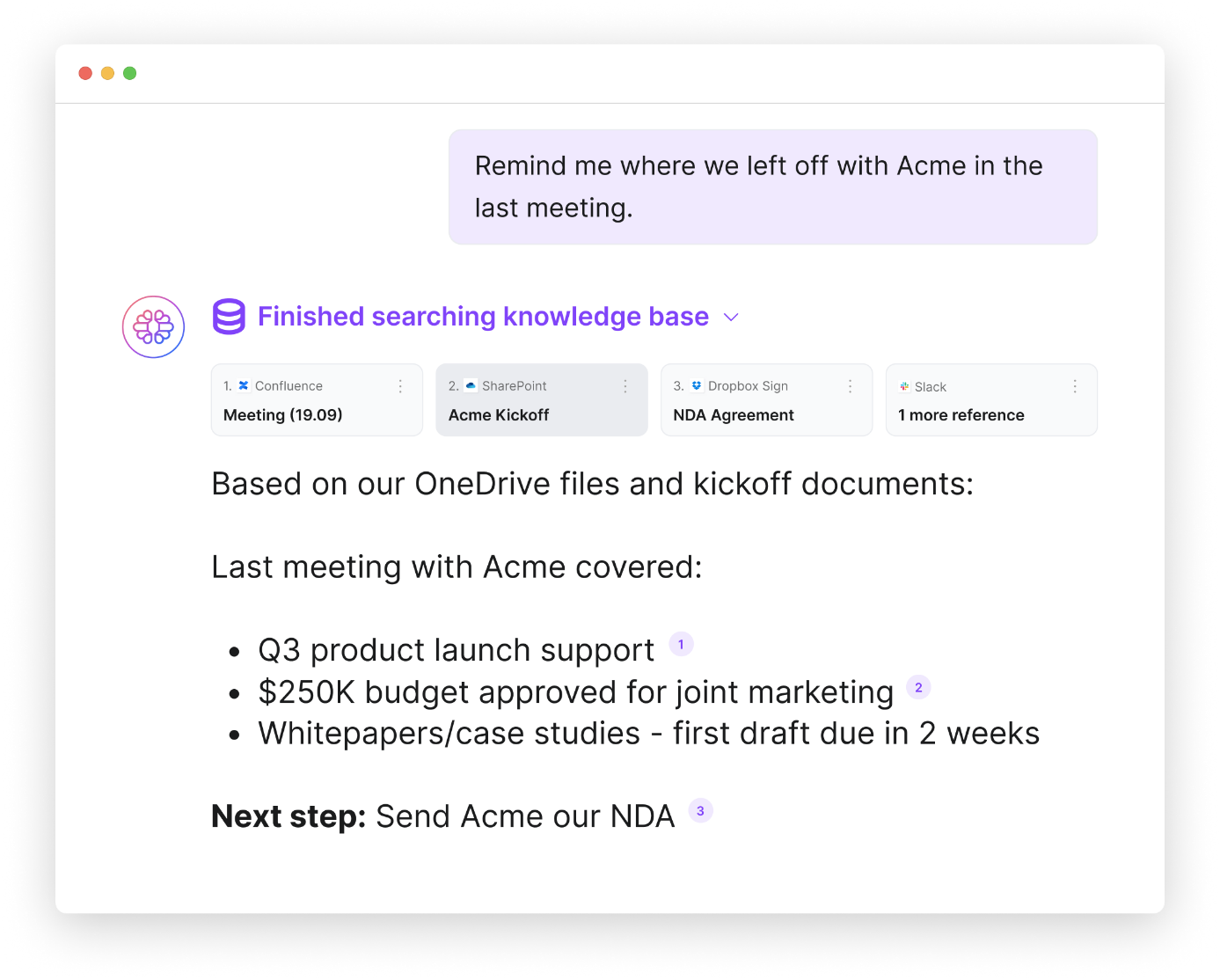
You can manually upload your data and documents to TextCortex knowledge bases or connect your existing knowledge sources such as Microsoft OneDrive, Google Drive, and Notion with a single click. Moreover, you can organize your documents and internal data by creating knowledge base files.
TextCortex Workflow Automation
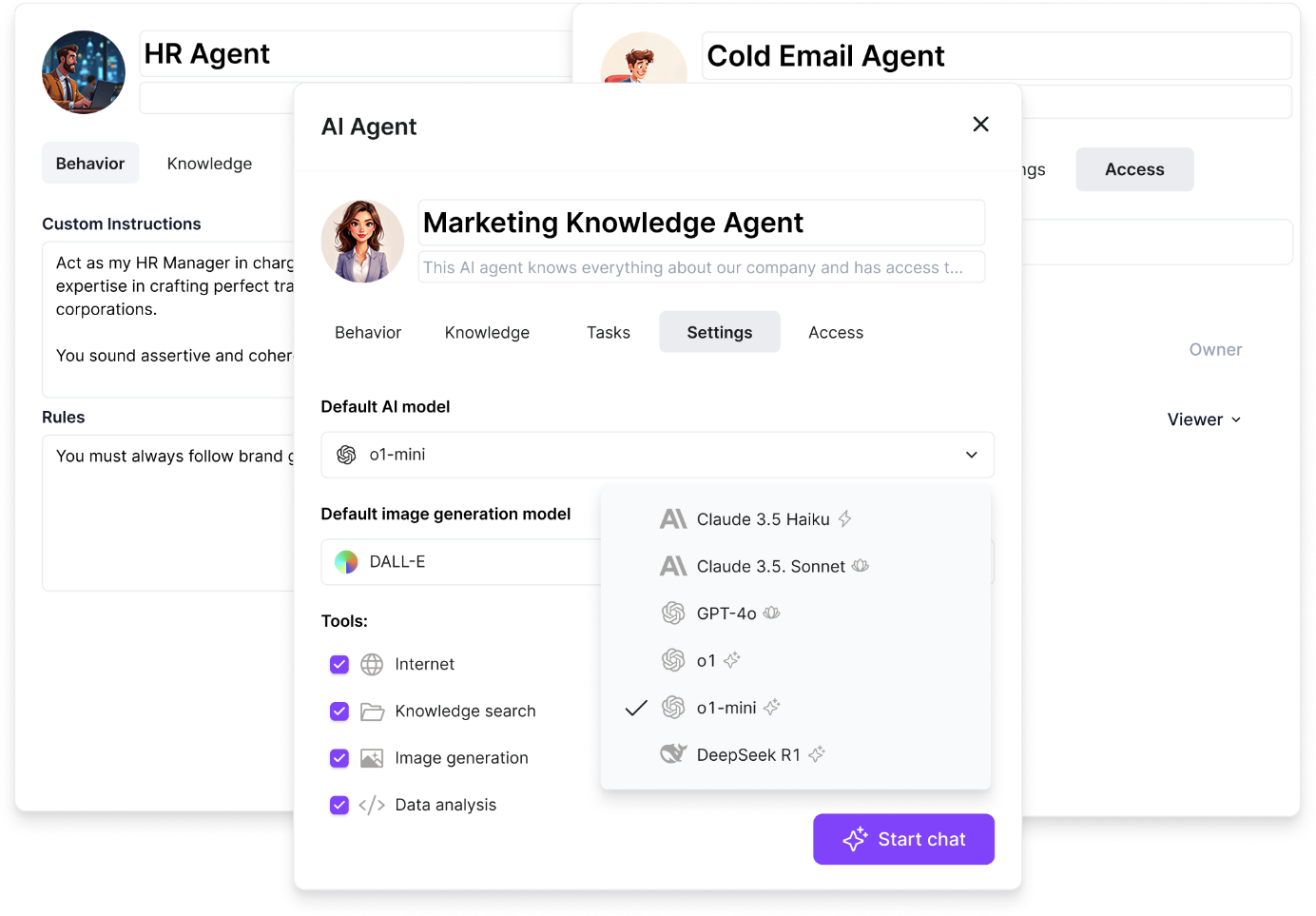
TextCortex offers automation of repetitive and monotonous tasks to all its users, including enterprises. With TextCortex AI agents, you can automate any repetitive workflow of your business and save time! TextCortex AI agent works integrated with your knowledge base and can complete tasks using your internal data. For example, using the TextCortex AI agent feature, you can build an assistant that will automate HR manager tasks and help you save time.
Writing Assistance
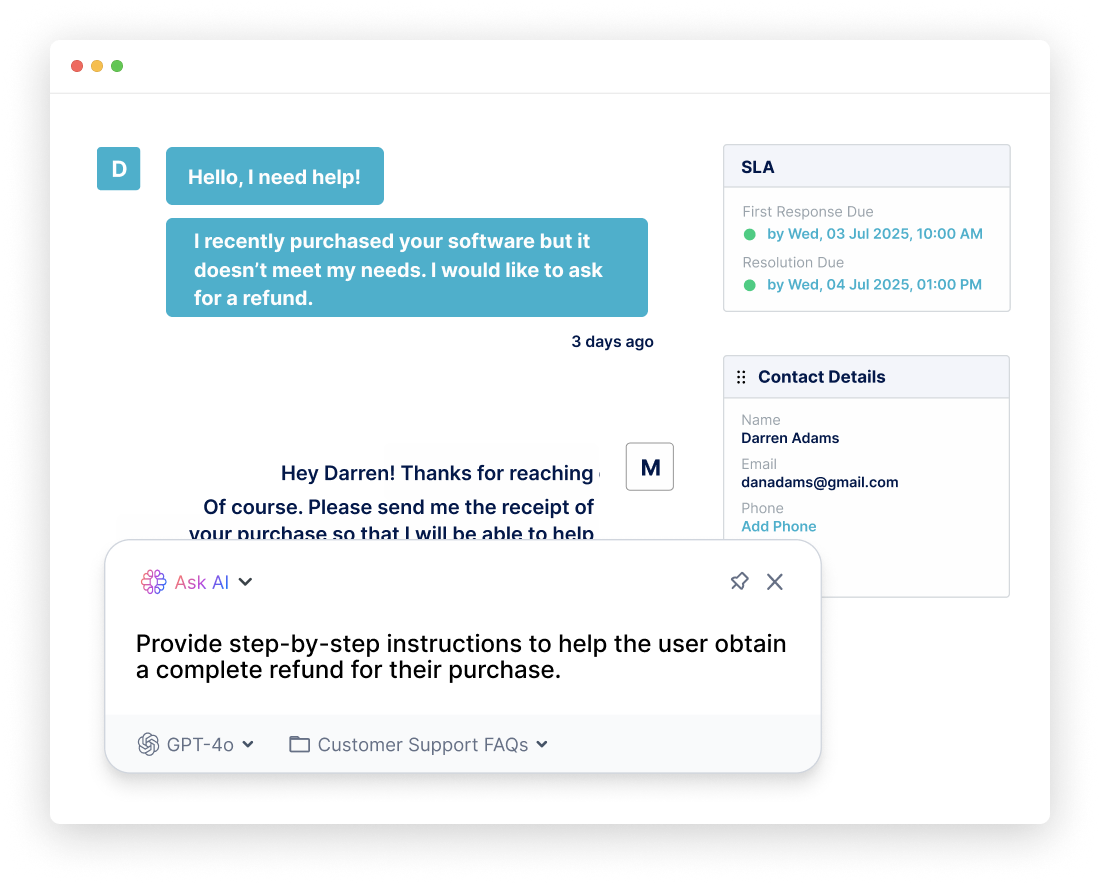
If you need to create documents frequently or want to make your enterprise documents compelling, contextual, well-organized, and error-free, then TextCortex writing assistance is designed for you. Our writing assistance stabilizes your brand voice and ensures consistency in all your written documents.
Frequently Asked Questions
What is the difference between LLM and RAG?
LLM (Large Language Model) is one of the technologies an AI tool uses to generate textual output and understand inputs. RAG is an implementation that allows a large language model to retrieve the information it uses to generate output from specific databases.
Is there anything better than RAG?
Retrieval-augmented generation (RAG) is a technology that specifies the database used by large language models to generate output. Agentic RAG is an implementation that can perform more complex tasks and search multiple databases simultaneously.
What is the difference between RAG and fine-tuning?
When you implement retrieval-augmented generation (RAG) on a large language model, LLM always starts using your updated knowledge base to generate output. When you fine-tune an LLM, you train it with static data and build it for a specific purpose.
.png)
.png)
.png)