.png)
OpenAI released GPT-5.5, their most advanced large language model, on April 23, 2026. GPT-5.5 comes with new features and outperforms its predecessor, GPT-5.4. If you're curious about the new features of GPT-5.5 and the differences between it and GPT-5.4, we've got you covered!
TL; DR
OpenAI's GPT-5.5 launched on April 23, 2026, outperforming GPT-5.4 across latency, token efficiency, benchmarks, and use cases. It delivers superior agentic coding, computer use, document generation (spreadsheets, slides), and multi-step technical/scientific research, while using fewer tokens to produce higher-quality output. API pricing is double that of GPT-5.4 at $5 per million input tokens and $30 per million output tokens, though improved efficiency partially offsets the increase. Access it through ChatGPT Plus ($20/month), OpenAI API, Codex, or enterprise platforms like TextCortex for workflow automation and knowledge-base integration.
What is GPT-5.5?
GPT-5.5 is a large language model developed by OpenAI and released on April 23, 2026. GPT-5.5 is superior to its predecessor, GPT-5.4, in terms of both performance and use case diversity. However, GPT-5.5 outperforms GPT-5.4 in areas such as latency, token usage, pricing, performance, and use cases.
How to Access GPT-5.5?
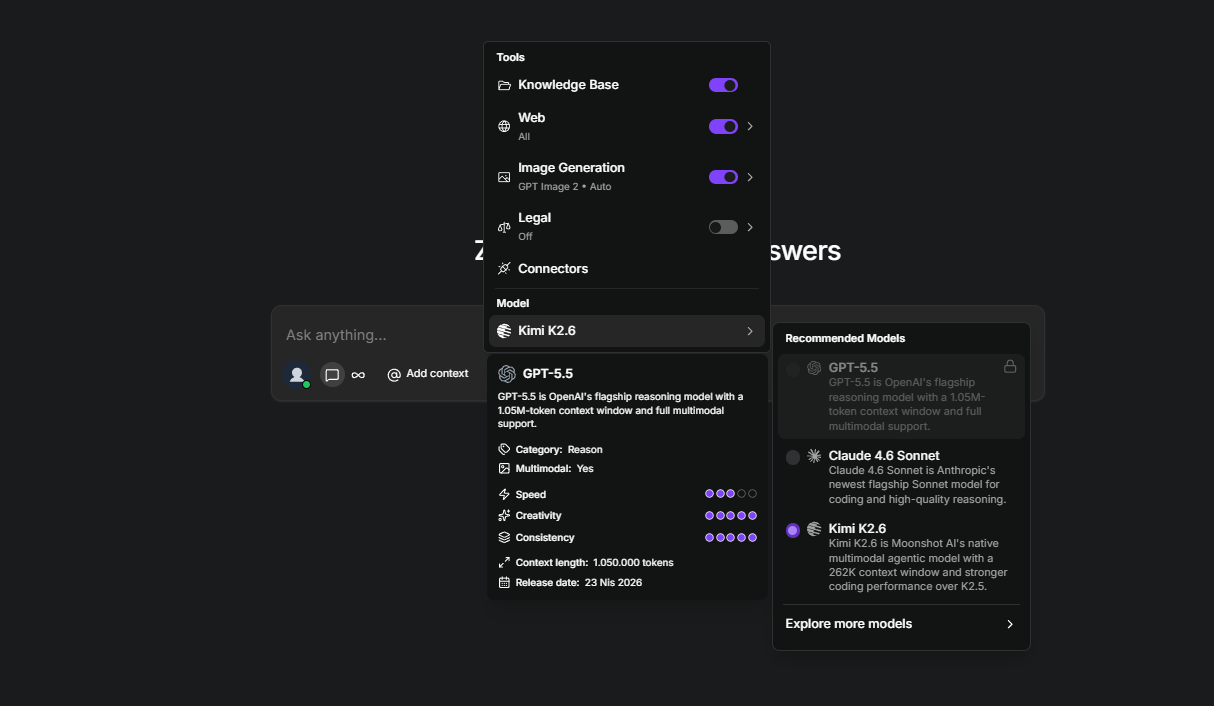
There are three main methods for accessing the GPT-5.5 model. The easiest and fastest way is to use it via the ChatGPT AI chatbot. Another method is to use it as an API. You can also access the GPT-5.5 model with the OpenAI Codex. If you want to access the GPT-5.5 model in a way that will quickly integrate it into your enterprise workflow, TextCortex is the solution for you.
GPT-5.5 vs GPT-5.4: What’s New?
OpenAI's GPT-5.5 model brings new performance and efficiency standards, as well as new use cases. If you're curious about what the GPT-5.5 model has to offer, let's discover.
Pricing
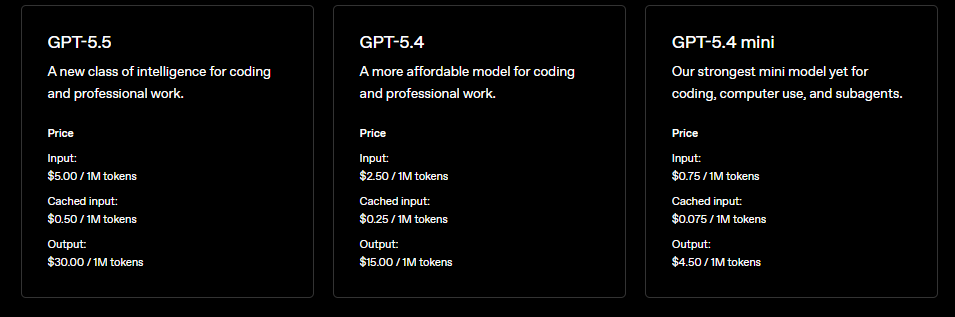
The biggest difference between the GPT-5.5 and GPT-5.4 models is pricing. The GPT-5.5 model charges twice as much API pricing as the GPT-5.4 model. While the GPT-5.4 model has a pricing of $2.5 per million input tokens and $15 per million output tokens, the GPT-5.5 model has a pricing of $5 per million input tokens and $30 per million output tokens. This difference means that the GPT-5.5 model is essentially twice as expensive.
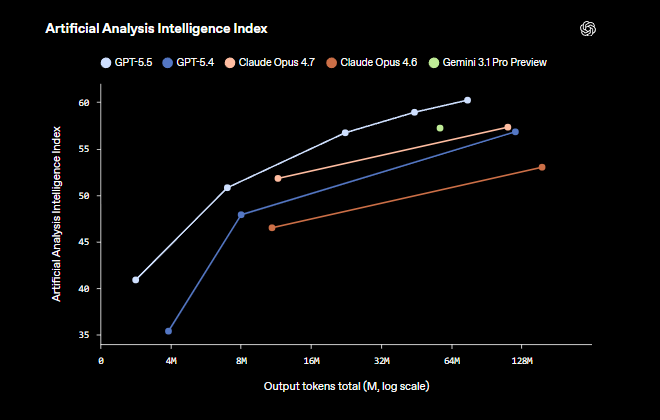
Another significant difference between the GPT-5.5 and GPT-5.4 models is their token usage. The GPT-5.5 model can generate higher-quality outputs using fewer tokens than the GPT-5.4 model. While this somewhat offsets the higher pricing of the GPT-5.5 model, it is still not as cheap as the GPT-5.4. In OpenAI's tests, the GPT-5.5 model managed to generate more intelligent outputs than the GPT-5.4 model while using significantly fewer output tokens.
Agentic Coding
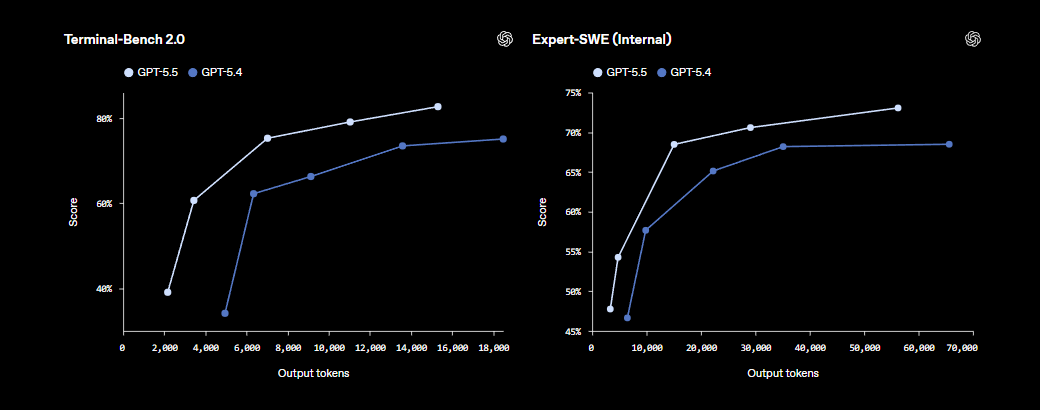
The GPT-5.5 model offers significantly better agentic coding performance compared to the selfie-oriented GPT-5.4 model. In Terminal-Bench 2.0 and Expert-SWE(Internal) benchmarks, which are used to measure the agentic coding capabilities of AI models, the GPT-5.5 model uses fewer tokens and generates better results than the GPT-5.4 model.
The GPT-5.5 model is superior to the GPT-5.4 model in areas such as debugging, code writing, engineering, testing, checking assumptions with tools, and holding context across large systems. In other words, with GPT-5.5, you can combine different codebases, use code from different projects simultaneously, identify potential output errors in advance, and quickly resolve coding errors.
Document Generation
The GPT-5.5 model produces better results than the GPT-5.4 model in documentation generation, such as documents, spreadsheets, and slide presentations. If you want to transform your raw material into informative knowledge, the GPT-5.5 model generates higher-quality and more usable outputs compared to the GPT-5.4 model.
Computer Use
The GPT-5.5 model offers a better computer usage experience than the GPT-5.4 model when used with applications like Codex that provide computer usage. The GPT-5.5 model is smoother than the GPT-5.4 model in accurate tool usage, application navigation, and basic computer usage skills such as clicking and typing.
Technical Research
While the GPT-5.4 model is useful in technical research, the GPT-5.5 model takes things a step further, performing better in hard questions and tasks requiring multi-stage scientific data analysis. Therefore, we can say that the GPT-5.5 model is useful in multi-step and precision-demanding tasks such as scientific research and technical analysis.
Benchmark Performance
The GPT-5.5 model scores higher than its predecessor, the GPT-5.4 model, in all benchmarks. For example, in the OSWorld-Verified and MMMU benchmarks, which are used to measure the computer use and vision performance of large language models, the GPT-5.5 model outperforms the GPT-5.4 model.
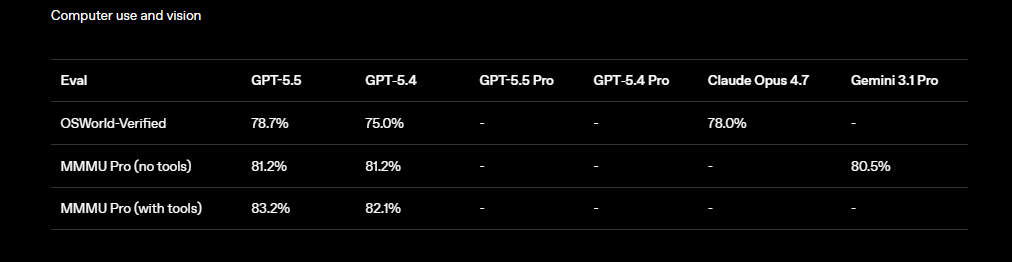
Furthermore, in benchmarks like GPQA Diamond, GeneBench, and Humanity’s Last Exam, which are used to measure AI models' reasoning, natural language, chemistry, and physics knowledge, the GPT-5.5 model performs better than the GPT-5.4 model.
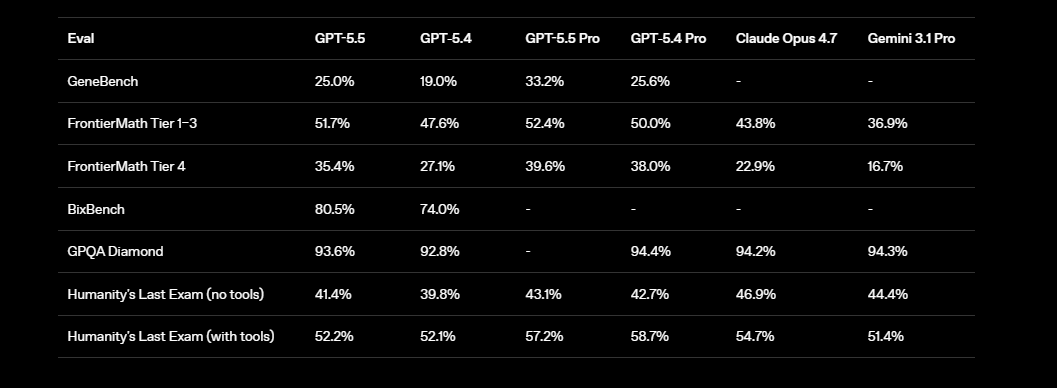
As a result of these benchmarks, we can say that the GPT-5.5 model outperforms the GPT-5.4 model in tasks such as coding, reasoning, writing, natural language, vision, computer use, and tool use.
TextCortex AI: Integrate GPT Models Into Your Business
If you want to integrate a wide range of large language models, including GPT-5.5 and GPT-5.4, into your enterprise workflow, optimized according to the difficulty and requirements of the tasks, and ensure a cost-performance equilibrium by using sufficient models to complete specific tasks, TextCortex is the solution for you. TextCortex is an AI infrastructure that aims to reduce the workload of enterprises and save them time by providing an AI agent framework for automation and knowledge bases for knowledge work.
TextCortex Features
TextCortex provides knowledge bases that allow users to upload internal data or connect to databases. With knowledge bases, you can create folders for different data groups. Another TextCortex feature is the AI agent framework, which integrates with knowledge bases. With the TextCortex AI agent builder, you can build AI agents to perform and automate specific tasks, and add your knowledge base data. You can build your AI agents manually with TextCortex or use our AI agent builder feature. Furthermore, TextCortex's wide range of LLM support including GPT-5.5 allows you to choose the optimal large language model for each task.
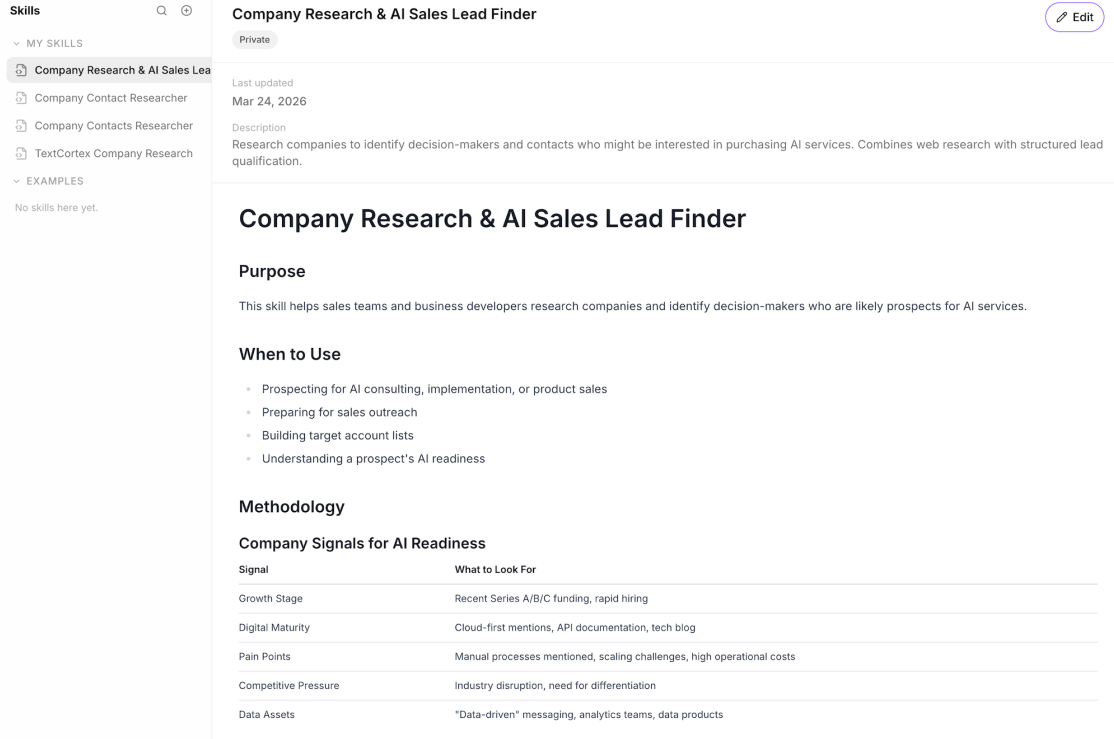
You can leverage our connectors and skills features to use your AI agents more effectively. With the skills feature, you can create prompt groups for specific actions and tasks and use them modularly in any of your AI agents.
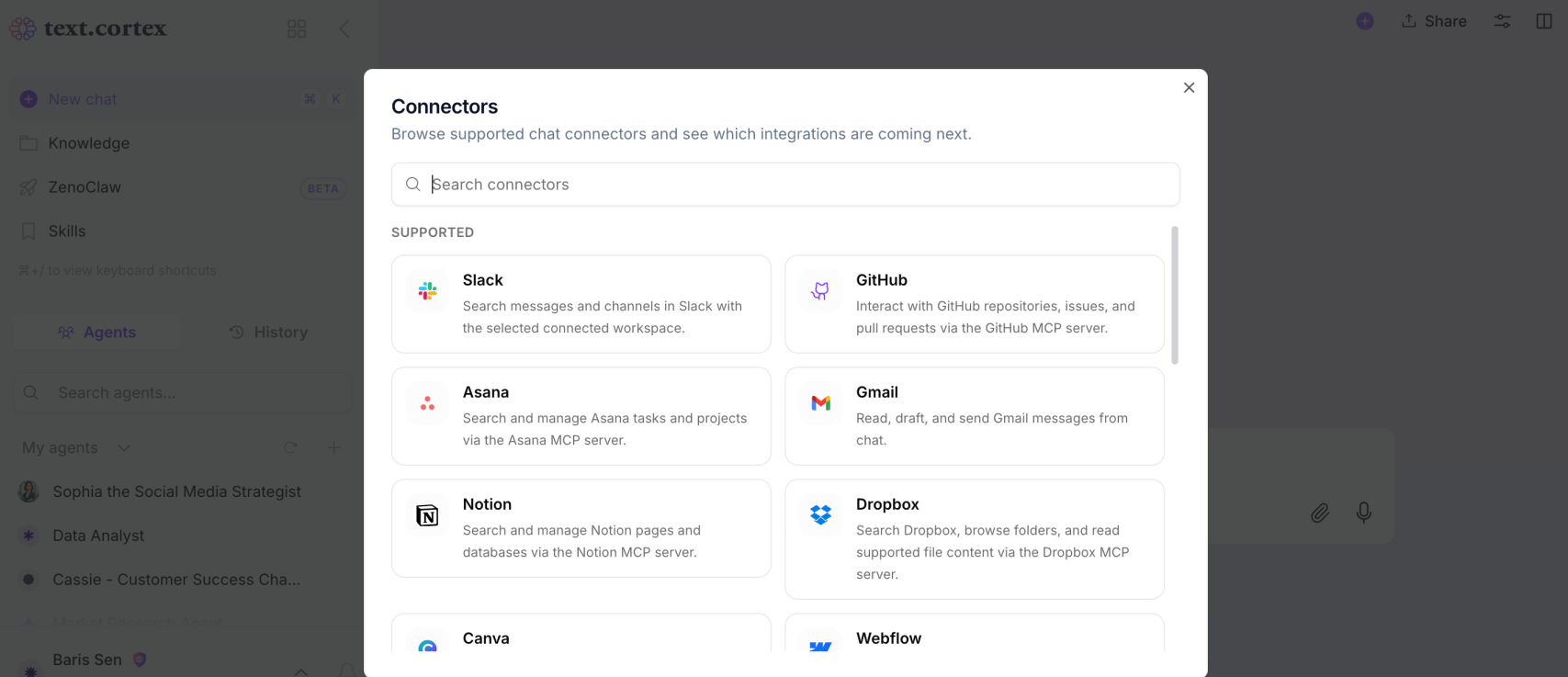
Our connectors feature allows you to integrate third-party apps into your skills or agents. For example, if you want a skill you've created to be activated in Slack, you can integrate Slack with a specific skill using connectors.
Frequently Asked Questions
What is the meaning of GPT-5.5?
GPT-5.5 is a large language model developed by OpenAI and released on April 23, 2026.
What is GPT-5.5 good for?
GPT-5.5 is a useful large language model for agentic coding, knowledge work, scientific research, automation, reasoning, and natural language tasks.
Is GPT-5.5 free?
To use the GPT-5.5 at full power, you need to purchase an OpenAI Plus or higher subscription which costs $20 per month.
.png)
.png)
.png)