
.png)
The penetration of AI technology into the daily lives and workflows of people and businesses has raised new concerns about AI. The training methods, outputs, or behaviors of AI tools can lead to outcomes that violate human rights or harm people. For example, there have been cases where Grook, the AI platform X (formerly Twitter), ignored language filters and insulted users. For this and similar reasons, the European Union enacted the EU AI Act to mitigate the risks of AI.
In this article, we will explore the European Union's approach to AI technology and its regulations.
Ready?
Let's dive in!
TL; DR
- European sovereign AI refers to the rules and regulations governing the development and deployment of artificial intelligence in European nations.
- The EU AI Act is a set of rules that classifies artificial intelligence systems based on their use and risk level.
- The European approach to AI refers to optimizing artificial intelligence for human health and safety.
- To optimize AI models for EU AI Act compliance, you can make them GDPR and ISO 27001 compliant and meet the requirements of the EU AI Act levels.
- If you want to integrate an EU AI Act and GDPR-compliant AI model into your enterprise, TextCortex is the solution for you.
Europe Sovereign AI
European sovereign AI refers to efforts by European nations and the EU to develop and deploy artificial intelligence that aligns with European values, regulations, and strategic interests, aiming for technological independence from major non-European powers and fostering trust and privacy. Europe's sovereign AI's key aspects include building local AI infrastructure and data capabilities, developing trustworthy and explainable AI models, and ensuring regulatory compliance, such as the EU AI Act, GDPR, and ISO 27001.
What is the EU AI Act?
The EU AI Act is the first set of rules for the development and use of artificial intelligence, covering 27 countries within the European Union. The EU AI Act offers four different risk-based approaches, depending on the AI model and the system used. The EU AI Act covers four risk levels:
- Unacceptable Risk
- High Risk
- Limited Risk
- Minimal Risk
European Approach to Artificial Intelligence
The European Union has a citizen-focused approach to AI technology. Therefore, any AI model operating within the EU must complete certain steps. If you want to adapt your company to the European approach and use AI models within the EU, there are certain steps you must complete.
1. Privacy Engineering
Implement privacy-first development strategies such as data minimization, differential privacy, and encryption. Adopt privacy standards that meet the requirements of frameworks like GDPR and ISO 27001. This ensures your AI model is compliant with both current and upcoming regulations.
2. Detect EU AI Act Risk Level
Analyze which EU AI Act risk levels your AI model complies with and identify which of your applications do not meet the EU AI Act risk standards. This will allow you to identify the AI systems you need to develop or modify to enable your AI model to operate in the EU. Prioritize developing the AI components that are considered high risk.
3. Tech Stack Review
Replace non-compliant AI tools with EU-based, GDPR-compliant alternatives to minimize legal risks. Examine all layers of your AI model usage and prioritize transparency. This way, you can achieve transparent, explainable, observable, and traceable AI model usage and meet the requirements of the EU AI Act.
4. Monitoring
Add a feedback loop to your AI model to allow it to adapt to upcoming regulations and evolving business needs. This allows you to implement systems like compliance tracking with real-time alerts and ensures your AI system is always safe.
5. Get Professional Help
If you want your company to be able to work with AI systems in the European Union, you can choose to use AI platforms that are already compliant with EU regulations and GDPR, rather than implementing an AI system from scratch. For example, TextCortex offers its users solutions such as GDPR and ISO 27001-compliant AI knowledge management, AI automation, and documentation assistance.
TextCortex AI: Your EU-based Enterprise AI Solution
TextCortex is an enterprise AI platform developed for those looking to add the power of AI to their organizations in the EU. TextCortex provides GDPR and EU AI Act compliance, allowing users to freely use AI models in the EU, reducing workload and increasing productivity.
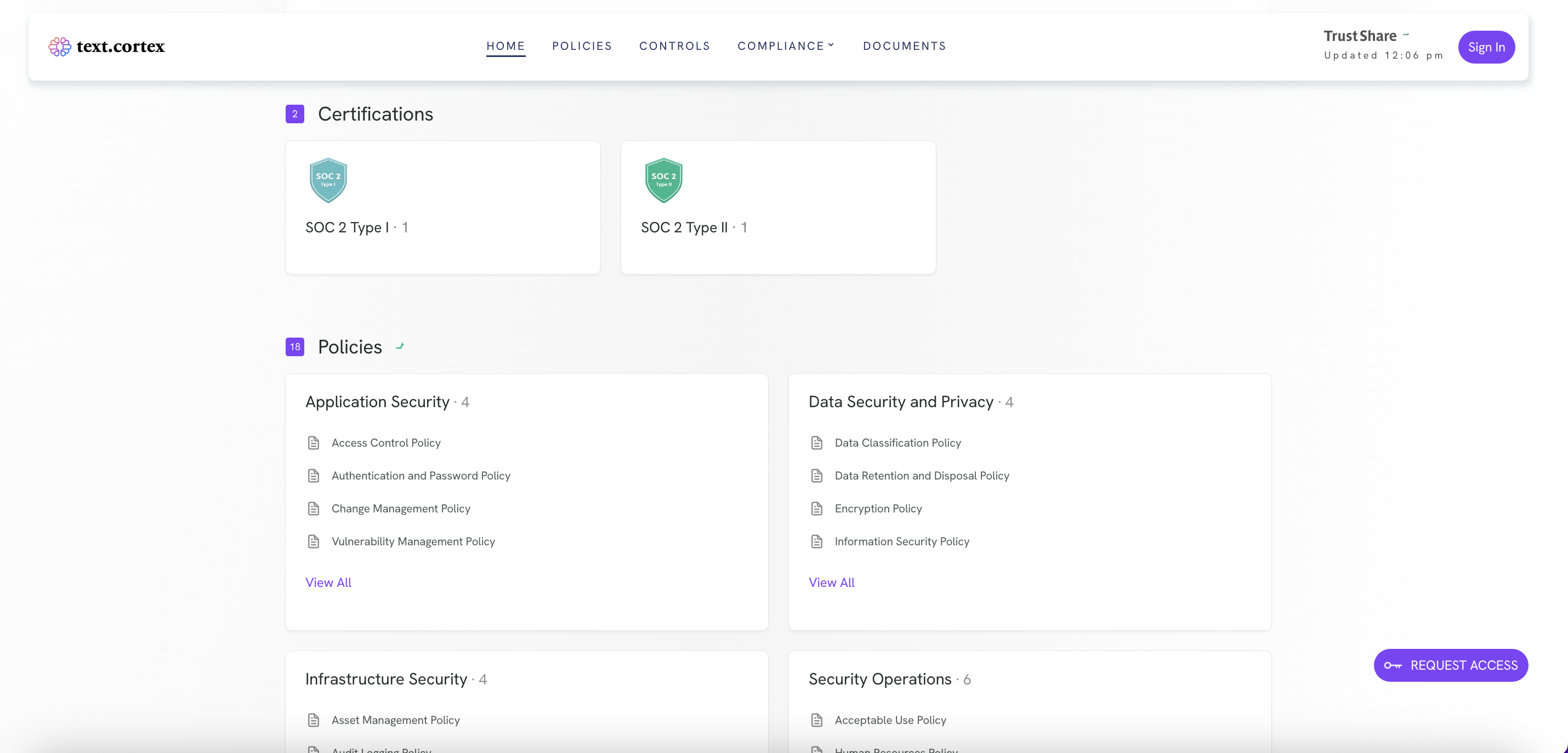
TextCortex also holds SOC 2 Type I and Type II certifications and adheres to ISO standards. If you're looking to integrate an AI platform that prioritizes security and privacy into your enterprise in the EU, you too can join over 2 million users and hundreds of other enterprises!
Let's take a closer look at the enterprise solutions TextCortex offers.
Enhanced Knowledge Management
Knowledge management has always been a challenging and arduous process for businesses and organizations. Fortunately, the advancement of artificial intelligence has made knowledge management much more actionable and straightforward. TextCortex leverages agentic data retrieval and conversational AI models to optimize knowledge management for its users. With TextCortex, you can create custom knowledge bases and build custom AI agents that can use them as data and generate output. For example, you can leverage TextCortex to analyze marketing data; here's how:
Automate Workflows and Save Time
TextCortex offers AI agents to save time for enterprise users. With our AI agents, you can build custom AI agents to automate repetitive and complex workflows, allowing you to save time and maintain business standards. Another advantage you gain when building AI agents with TextCortex is that they can work with your knowledge base. Do you want to speed up and automate the SOP writing process? No problem, TextCortex is the solution!
Enhance Your Writing
In enterprises, clear and organized documentation is a crucial part of operation. By integrating TextCortex into your enterprise, you can enhance documentation, writing, and reporting across your employees and boost productivity. Check out one of our case studies:
- Reduction of internal expertise search time from minutes to seconds
- 10-12% more efficient proposal creation
- Employee confidence in working with AI improved from 8/10 to 10/10
- Employee enthusiasm toward AI increased from 25% to 67%
- 94% of employees report that AI improves their work quality
Frequently Asked Questions
What is the European approach to AI?
The European approach to AI centers on human safety, transparent data flow, and ensuring that AI models generate explainable outputs. This ensures that people do not fear that their sensitive data will be leaked or that AI may generate discriminatory outputs when using AI models.
What are the 4 levels of EU AI Act?
The EU AI Act categorizes AI models into four different risk groups, each with different regulations and requirements. The four levels of the EU AI Act include:
- Unacceptable
- High
- Limited
- Minimal
Why is the EU AI Act good?
The EU AI Act is a good approach because it aims to prevent potential harms by evaluating artificial intelligence systems according to four different risk categories.
.png)
.png)
.png)