
.png)
Anthropic decided to upgrade its smartest model, the Opus, and released the Claude Opus 4.6 on February 5, 2026. The Claude Opus 4.6 offers both more advanced features and higher performance compared to its competitors. If you already own a Claude series model and are curious about what the Opus 4.6 has to offer, we've got you covered!
In this article, we will explore the Claude Opus 4.6 and examine its performance.
Ready?
Let's dive in!
TL; DR
- Claude Opus 4.6 is a large language model developed by Anthropic and released on February 5, 2026.
- You can access Claude Opus 4.6 through one of the Claude AI premium plans or as an API.
- Claude Opus 4.6 outperforms its predecessors and competitors in agentic reasoning, tool use, and agent-related benchmarks.
- Claude Opus 4.6 is optimized to perform long context retrieval and reasoning tasks with high quality.
- If you want to automate your enterprise workflow and enhance your knowledge management with your preferred LLM, TextCortex is the solution for you.
Claude Opus 4.6 Review
The Anthropic team dropped Claude Opus 4.6, their latest large language model, on February 5, 2026. Claude Opus 4.6 offers higher performance, safer usage, improved coding skills, and agentic capabilities compared to its predecessor, Opus 4.5. Like all Claude models, Claude Opus 4.6 provides users with a context window size of up to 1 million tokens. Claude Opus 4.6 can perform not only coding and agentic tasks but also everyday tasks such as financial analysis, conducting research, and creating documents.
Claude Opus 4.6 Pricing
The Claude Opus 4.6 model currently offers the same API pricing as the Claude Opus 4.5 model. Therefore, you can upgrade from Claude Opus 4.5 to 4.6 without any pricing change or extra cost. The token pricing for Claude Opus 4.6 is:
- $5 per million input tokens
- $25 per million output tokens
- $6.25 per million 5-minute cache writes
- $10 per million 1-hour cache writes
- $0.50 per million cache input tokens

How to Access Claude Opus 4.6?
There are three main ways to access the Claude Opus 4.6 model. The first method is to use the Claude Opus 4.6 model through Claude AI. Once you head to the Claude AI webapp, you can select the Opus 4.6 model from the chat settings and start using it to generate output, execute tasks, and conduct regular chats. However, if you want to use the Opus 4.6 model through Claude AI, you need to subscribe to one of its premium plans.
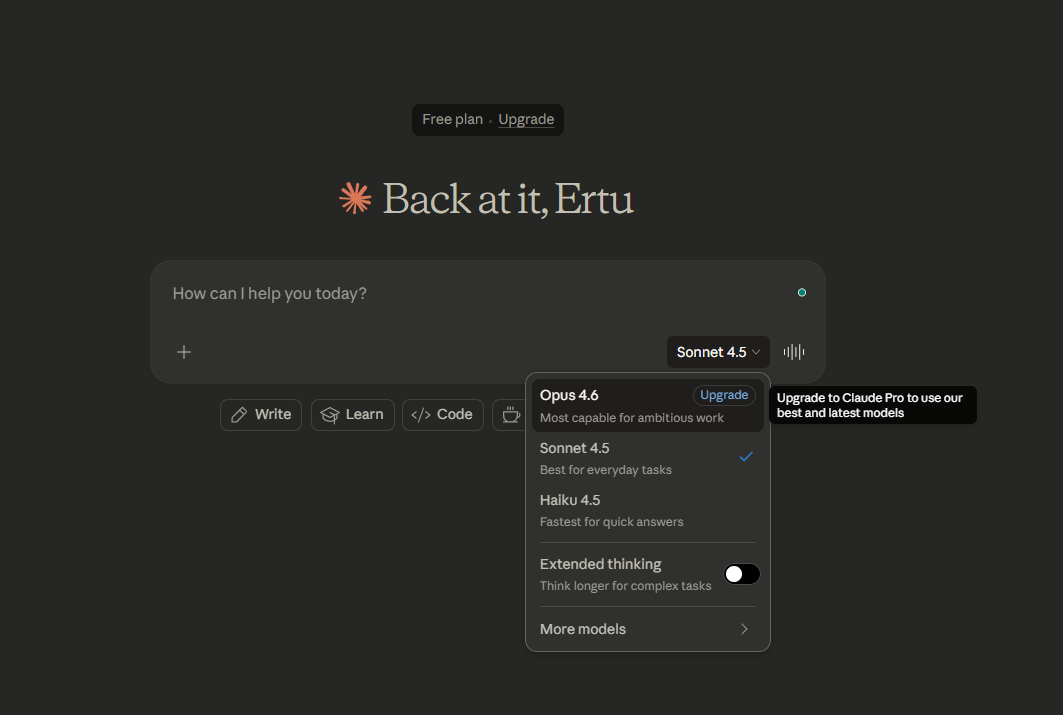
Another way to access the Claude Opus 4.6 model is to use it as an API. If you are already using the Claude Opus 4.5 model, you do not need to pay any extra fees to access the Opus 4.6 model, as the pricing is the same for both.
A third way to access the Claude Opus 4.6 model is to use it via Claude Code. Using Claude Code, you can use the Opus 4.6 model to build AI agents or integrate it into your codebase.
Claude Opus 4.6 Features & What’s New
The Claude Opus 4.6 model has managed to outperform its predecessor, the Claude Opus 4.5, in coding, text generation, reasoning, and agentic performance benchmarks. We can say that the Opus 4.6 is a better version of its predecessor, and at the same price. Let's take a closer look at the features of the Claude Opus 4.6.
Claude Opus 4.6 Task Performance
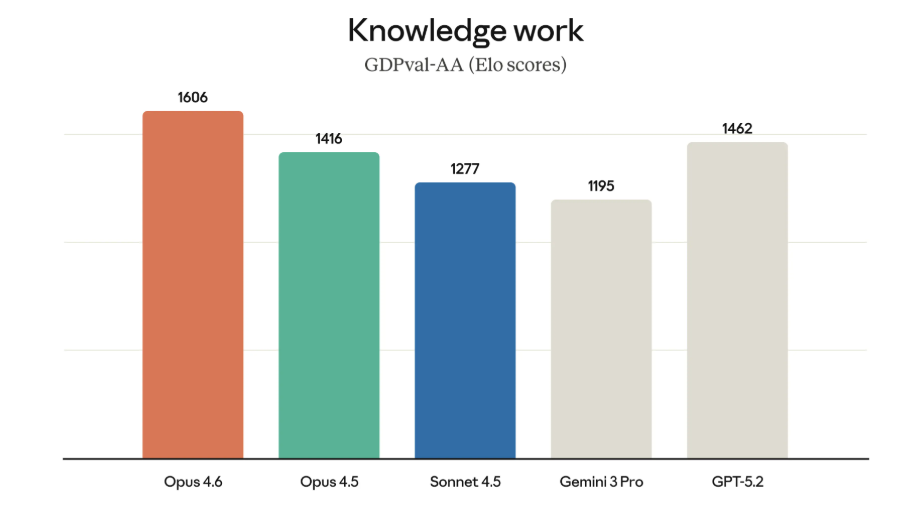
The Claude Opus 4.6 model demonstrates higher performance in company use cases compared to its predecessors. For example, in tasks requiring knowledge work, the Claude Opus 4.6 model outperforms both its predecessors and competitors.
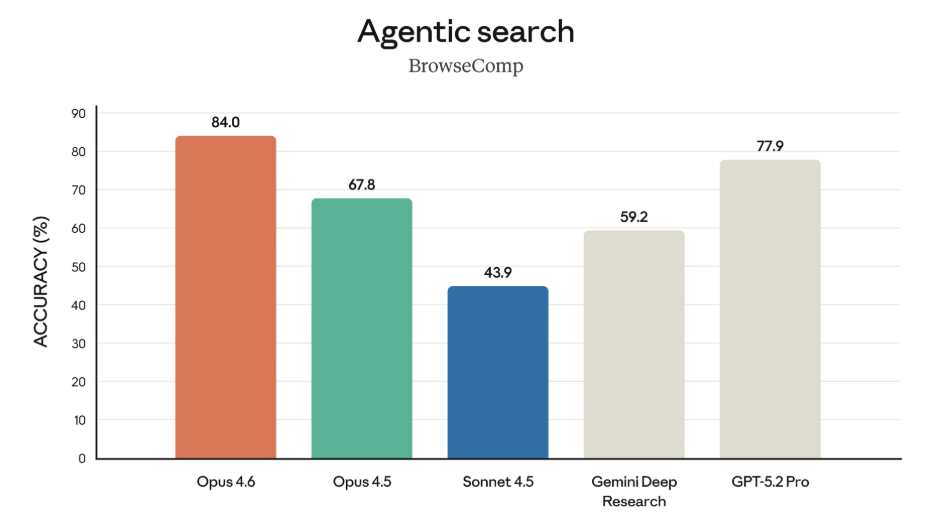
As large language models are increasingly optimized for automation, the Claude Opus 4.6 model demonstrates higher agentic performance than both its competitors and predecessors. In the agentic search benchmark, the Claude Opus 4.6 model has the highest score, while its closest competitor is the GPT-5.2 Pro model.
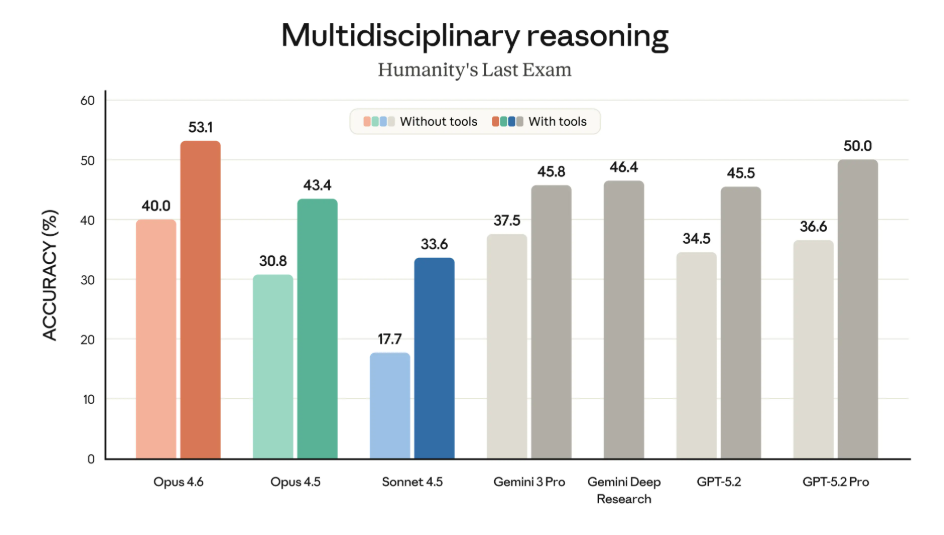
Claude Opus 4.6, in the Humanity’s Last Exam benchmark used to measure the multidisciplinary reasoning performance of AI models, delivers higher performance than its competitors and predecessors, both with and without tools. Furthermore, the Claude Opus 4.6 model thinks more deeply and carefully before performing reasoning tasks.
Agentic and Tool Use Performance
State-of-the-art models like the Claude Opus 4.6 are developed to be suitable for agentic use. Therefore, the Anthropic team prioritized improving the agentic and tool-use capabilities of the Opus 4.6 model during its development.
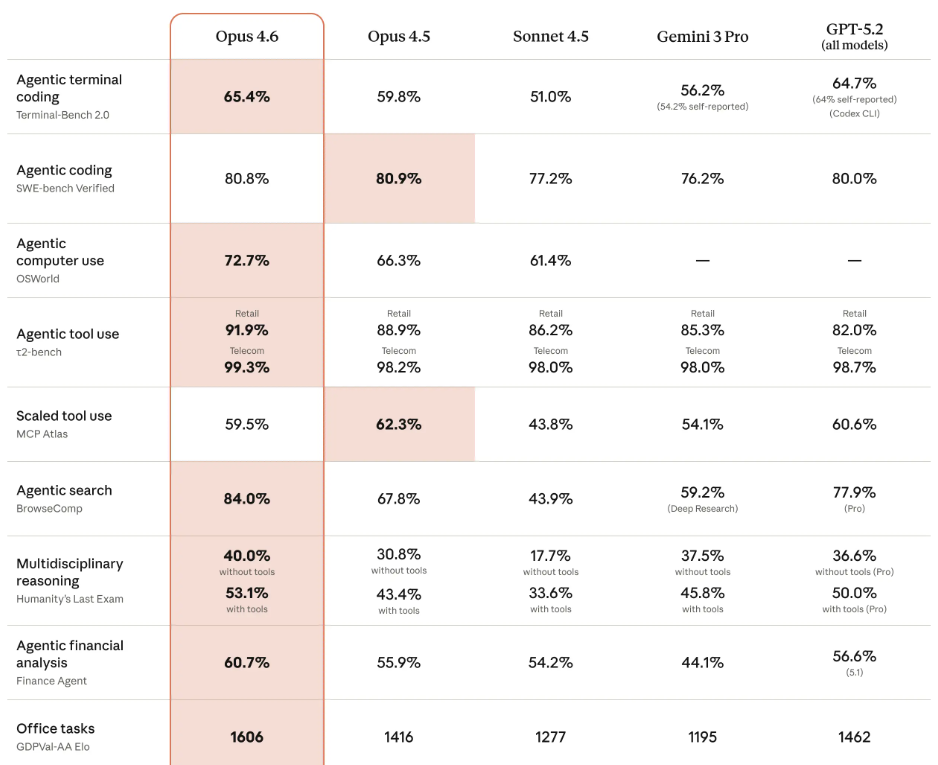
As seen in the benchmark results above, the Claude Opus 4.6 model scores higher than its competitors in everyday office tasks, tool-requiring tasks, and agentic tasks.
Long Context Performance
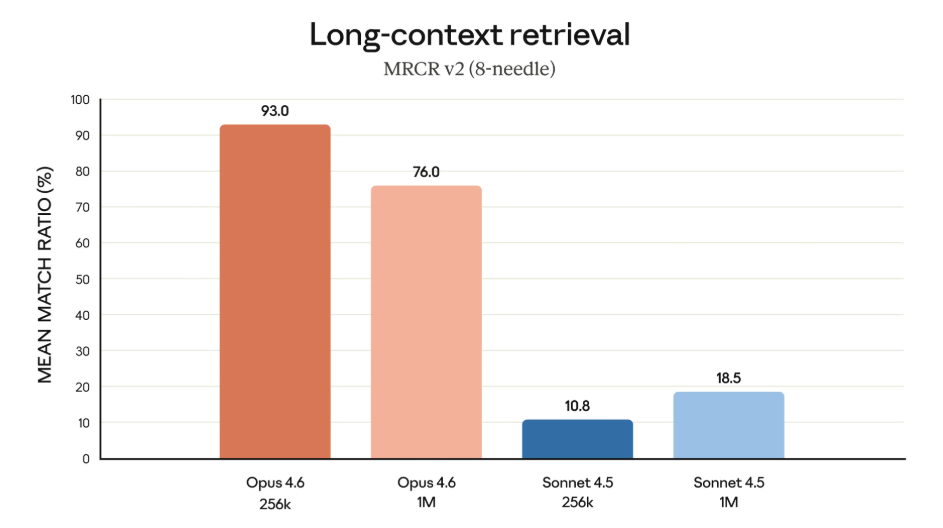
AI tools must understand long contexts, accurately recall data, and avoid generating hallucinatory output when processing long contexts in order to function effectively in a corporate environment. Anthropic AI aims to provide users with better performance in long contexts by understanding context rot, the problem of AI models deviating from the context after exceeding a certain token limit. In this context, the Claude Opus 4.6 model offers almost twice the long context retrieval and reasoning of its predecessors.
Claude Developer Platform: New Features with Opus 4.6
If you plan to use the Claude Opus 4.6 model as an API, you can start using it with new features. The new features of the Claude API include:
- Adaptive Thinking: Allows you to autonomously control the extended thinking feature. • Effort: You determine how intensively the model will work by choosing one of four effort options.
- Context Compaction (Beta): Summarizes long conversations stuck in the context window and moves them to the next context window limit, allowing you to experience smoother long-context conversations.
- 1M Token Context (Beta): The Opus 4.6 model is the first Opus model to have a 1 million token context window.
- 128K Output Tokens: The Opus 4.6 model can generate up to 128K tokens of output.
- US-Only Interface: You can access the interface specifically designed for United States regulations for a price of 1.1xTokens.
TextCortex AI: European AI Platform
If you want to automate your workflow, enhance your knowledge management, and complete both professional and everyday tasks much faster and with higher quality by integrating a wide range of high-end LLMs, including Claude models, into your enterprise tasks, then TextCortex is for you. TextCortex is a leading knowledge management and workflow automation tool that aims to lighten the workload of its users and save them time.
Create AI Automations
TextCortex offers users the ability to create AI agents with a wide range of large language models, including Claude Opus 4.5. With the TextCortex AI agent builder, you can specify the default model for your AI agent during the building phase. For example, if you are building an AI agent for a workflow that requires advanced reasoning, long context retrieval, and coding skills, you can choose one of the models, such as GPT-5.2 or Claude Opus 4.5, as the default. There are two methods for building AI agents with TextCortex: autonomous and manual. To build an AI agent autonomously, simply log in to the TextCortex web application and click the "+" symbol in the agent menu on the left. On the screen that opens, click "Create with AI" and proceed with the "Alex, the Agent Builder" option.

If you prefer to build your AI agent manually, you can skip clicking the "Create with AI" button and create your AI agent by filling in the required fields. You can also test and fine-tune your AI agent in the Chat Preview section.
Enterprise AI Search
You can take your knowledge management to the next level with TextCortex knowledge bases. TextCortex knowledge bases integrate with AI agents and generate output using databases you connect to or upload. Using this feature, you can quickly find the documents, pieces of information, and data you're looking for, or turn your documents into insightful reports.
Frequently Asked Questions
Is Claude Opus 4.6 free?
No, Claude Opus 4.6 is not free. Claude Opus 4.6 has the same API pricing as Opus 4.5. If you want to use Opus 4.6 as an AI chatbot, you need to purchase one of the paid subscriptions for Claude AI.
How to use Claude Opus 4.6?
To use the Claude Opus 4.6 model, you need to purchase a Claude AI subscription or generate an API key.
What’s the difference between Opus 4.5 and 4.6?
The biggest difference between the Claude Opus 4.6 model and its predecessor, Opus 4.5, is its improved long-context reasoning and retrieval performance. Additionally, the Opus 4.6 model is more successful than its predecessor, the 4.5 model, in agentic reasoning and tool use.
.png)
.png)
.png)