%20(3).png)
AI agents are being deployed across enterprises and organizations to reduce workload and enable more efficient operations. They can be configured for a wide range of functions, from customer support and HR workflows to documentation and finance, and they keep improving through experience.
In this article, we'll explore what AI agents are and examine best practices for deploying them across enterprise departments.
TL;DR: AI agents are AI assistants that can be assigned objectives and make independent decisions to complete them. They use natural language processing, deep learning, machine learning, and parameters to perform tasks autonomously. Key use cases include documentation and knowledge management, customer support, IT support, HR processes, finance, and sales and marketing automation. TextCortex helps enterprises deploy purpose-built AI agents on their own data across all of these functions.
Introduction to AI Agents
AI agents are AI assistants that can be assigned objectives such as email writing, customer support, and data analysis. AI agents analyze company knowledge to complete assigned tasks, determine the documents and subtasks they need, and make the necessary decisions to achieve the objectives. With AI agents, you can automate most of your tasks and reliably get consistent outputs.
How AI Agents Work
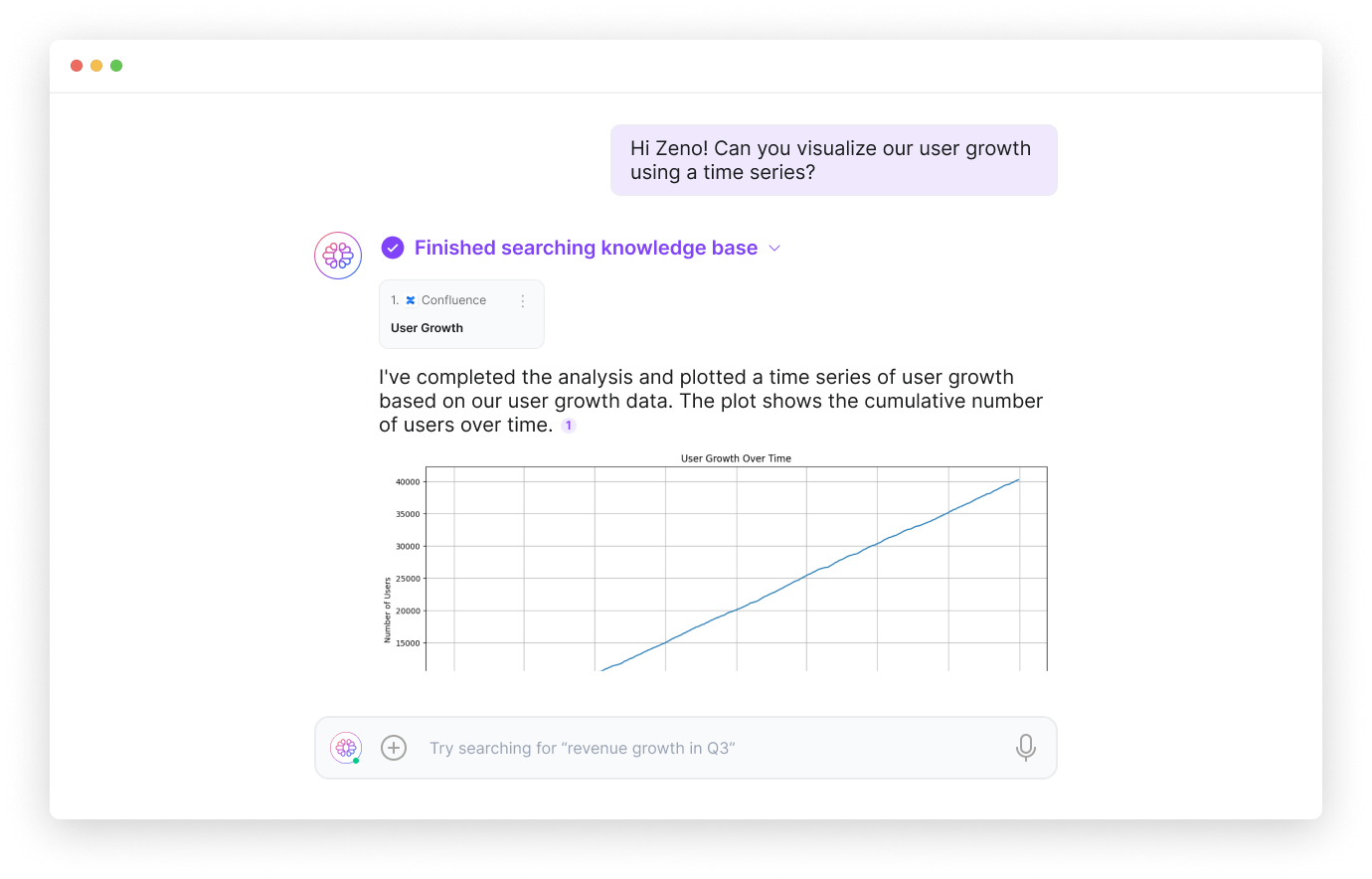
AI agents use technologies such as natural language processing, deep learning, machine learning, and parameters to make decisions and perform tasks. For example, if you assign an AI agent to the email reply writing task, it reads and understands the received email, retrieves the information it needs from your company knowledge base, and writes a personalized reply. The entire process completes in under a minute, saving your employees time on each interaction.
Benefits of AI Agents
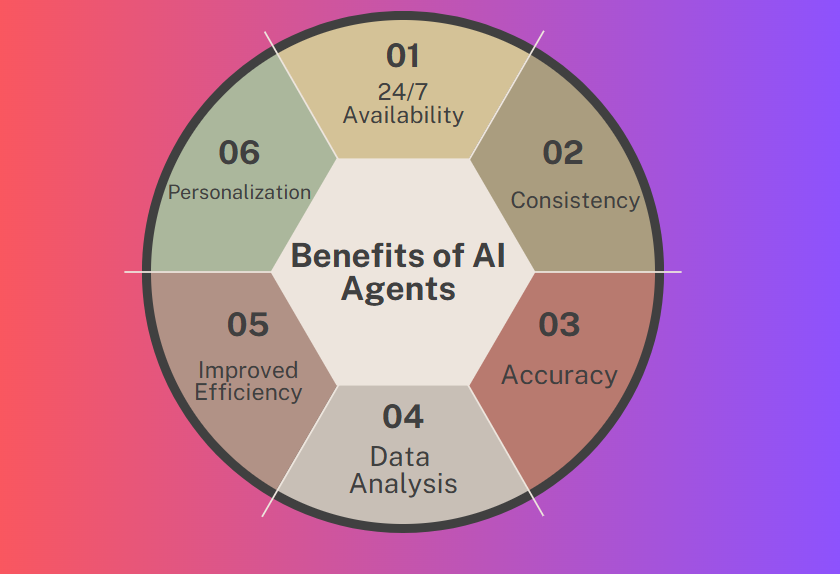
AI agents come with a variety of benefits for both your organization and your employees. The major benefits include:
- 24/7 Availability
- Consistency
- Accuracy
- Data Analysis
- Improved Efficiency
- Personalization
6 Types of AI Agents
AI agents have 6 different types according to their functions, decision mechanisms, and areas of use. Among these types, learning AI agents adapt fastest to enterprise environments: they generate more concise and high-quality outputs by self-training on user feedback and conversations.
- Simple Reflex Agents
- Model-Based Agents
- Utility-Based Agents
- Goal-Based Agents
- Learning Agents
- Hierarchical Agents
AI Agents Use Cases and Best Practices
AI agents can be deployed in different departments to increase the overall efficiency of the organization. You can use AI agents in customer support to create a more consistent email response process, integrate them into your AI chatbot for higher-quality customer interactions, or assign them to knowledge management tasks to keep your knowledge base organized and searchable. Here are the best practices by department.
For IT Support
AI agents ease the IT department's workload and automate routine tasks across 3 main areas.
Providing Information for Employees
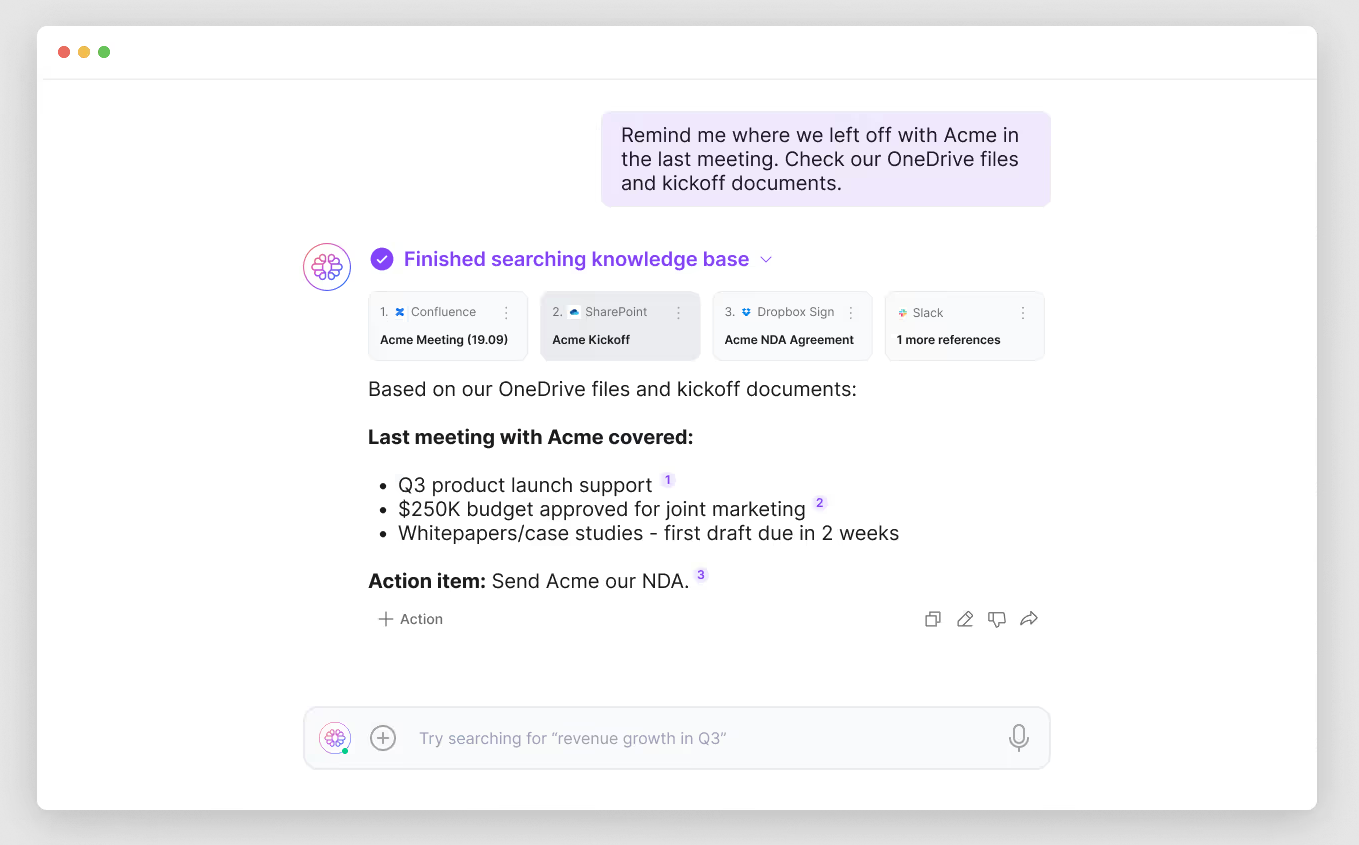
AI agents integrated with company knowledge bases enable employees to quickly access the information they're looking for. IT departments that frequently need to reference company knowledge save significant time when they can access data instantly rather than searching through documentation manually.
Basic Troubleshooting
Every company has troubleshooting issues that employees or customers frequently encounter. With AI agents, you can automate solutions to frequently occurring issues, resolving them without spending human resources on each instance. This frees IT staff for complex, non-routine problems.
Service Tickets and Requests
AI agents can automatically classify and balance tickets and requests. They analyze customer interactions and requests, create priority tickets, and forward them to the relevant department. This solves customers' priority problems faster and automates the entire ticketing process.
For HR Support
Employee Onboarding
AI agents can create customized onboarding checklist documents for each new employee and automate key onboarding tasks such as equipment setup, access provisioning, and approval management. They're effective for managing the entire onboarding process or just automating specific parts of it.
Employee Leave Management
AI agents help employees check their leave balances, submit requests, and track approvals. They document the entire process and forward it to the HR department, giving managers visibility without manual follow-up. This minimizes disruption when workforce gaps occur.
Information Finding
AI agents integrated with your company's knowledge resources enable the HR department to quickly access past documents or data they need across a wide range of tasks. They can also analyze current data and documents and turn them into the specific information HR needs on demand.
For Finance Support
Tax Filing Assistant
AI agents integrated with company data and tax-related records can automate repetitive tasks such as tax filing in the finance department, leaving staff with just double-checking rather than full manual completion.
Expense Management
AI agents streamline the entire expense approval process through automation. After employees submit expenses, the agent checks the documents against policies and forwards approved expenses to the finance department, reducing back-and-forth communication between employees and the finance team.
Payroll Information Retrieval
AI agents integrated with the finance department's knowledge base can provide automatic payroll information support for employees. With the agent's chat interface, employees can track their taxes, approved invoices, or awaiting approvals without contacting HR or finance directly.
For Sales and Marketing
Schedule Calls
AI agents can integrate with calendar systems and your sales team's call schedules to create separate call schedules for each employee, removing manual coordination from the process.
Email Reply
With AI agents, you can automate the email reading and replying process for your marketing and sales team. Agents analyze incoming emails, generate responses using data in the knowledge base, and prepare drafts your team can review and send quickly, cutting time spent on email writing significantly.
For Generic Use Cases
Documentation
AI agents are useful for completing documentation tasks thanks to their data analysis and text generation capabilities. You can automate any documentation creation process, from project proposals to technical document writing. You can also integrate AI agents with your organization's knowledge base to turn data in documents into actionable information and analyze it more effectively.
Customer Support
AI agents are especially well suited for reducing the workload of customer support departments. The most common deployment is as an automated AI chatbot: agents read customer questions, understand intent, analyze the company knowledge base, and write responses. Unlike traditional chatbots, AI agents can recognize when a customer needs human assistance and route them appropriately.
Automation
AI agents can automate many tasks by integrating with enterprise data using powerful large language models. The most common areas are data analysis, customer support, and document creation. TextCortex also offers Make.com and Zapier integrations, which let you automate any task in your company that connects to those platforms.
TextCortex: Enterprise AI Agent Platform
TextCortex is an EU-based enterprise AI platform that offers automation, web search, knowledge management, document creation, summarization, powerful RAG, and personalization features for both individual and enterprise users. With TextCortex, you can automate repetitive tasks such as email writing, summarization, and document creation, and use it for data analysis, customer support, and knowledge retrieval by uploading your internal data. TextCortex is available as a web application and browser extension integrated with 30,000+ apps and websites.
See results from Kemény Boehme Consultants (KBC):
- Employees report increased efficiency and productivity (saving 24 hours per month on average)
- AICX, an ecosystem partner of TextCortex, helped achieve a 70% team activation rate within the first weeks
- Employee confidence in using and working with AI increased by 60%
- The implementation results in a 28x return on investment (ROI)
TextCortex is ISO 27001 certified, SOC 2 certified, fully GDPR and EU AI Act compliant, serving Fortune 500 and DAX 40 customers worldwide. Sign up to start deploying AI agents across your enterprise workflows.
Frequently Asked Questions
What are the use cases for AI agents?
AI agent use cases vary depending on the needs of your enterprise. Some of the most common use cases include automation, customer support, document creation, data analysis, finance workflows, personal assistance, and supply chain management. Gartner projects that 40% of enterprise applications will include AI agents by end of 2026.
What is an AI agent in a real-life example?
AI agents are AI assistants that make decisions to complete given objectives. Real-life enterprise examples include email reply automation, customer support chatbots, and document creation workflows. See results from one of our case studies: KBC achieved 24 hours saved per employee per month, a 70% activation rate, and 28x ROI after deploying TextCortex agents across their team.
What is the application of agents in AI?
AI agents are suited for automating repetitive tasks and converting data into actionable information. They can provide support to your customers and employees, create schedules, and generate valuable insights. By integrating TextCortex into your enterprise, you can give employees faster access to information and automate tasks such as email writing, document creation, and customer support.
What departments benefit most from AI agents?
The departments with the clearest near-term ROI from AI agents are customer support (ticket handling, chatbots, escalation routing), IT (knowledge retrieval, basic troubleshooting), HR (onboarding, leave management), finance (expense management, payroll queries), and sales (outreach drafting, CRM hygiene). The common denominator is high-volume, repetitive tasks that follow predictable patterns.
How do AI agents improve customer support?
AI agents handle high-volume routine queries automatically, route complex cases to human agents, surface relevant knowledge base articles in real time for human agents, and ensure 24/7 availability without proportional staffing increases. Unlike traditional chatbots, AI agents understand context, recognize when a customer needs human help, and escalate appropriately rather than looping on scripted responses.
Can AI agents work with existing enterprise tools?
Yes. TextCortex integrates with SharePoint, Google Drive, OneDrive, Notion, Confluence, Make.com, and Zapier, meaning AI agents can operate across your existing data infrastructure without requiring a full system migration. The browser extension also makes agents accessible within 30,000+ apps and websites your employees already use.
.png)
.png)
.png)