
.png)
If you're looking for a more affordable alternative to Claude Opus 4.7 or GPT-5.5 to automate your enterprise workflow or complete your daily tasks more efficiently, GLM 5.1 is one of the LLMs you should consider. GLM 5.1 is a large language model that offers high performance at a much lower price. While it defaults to using servers in the US or China, TextCortex allows you to use it as EU-hosted and GDPR-compliant.
In this article, we'll examine the performance of GLM 5.1 and explore how to access it using EU-hosted.
TL; DR
GLM 5.1 is Z.AI's (formerly Zhipu AI) open-source, MIT-licensed large language model with 754 billion parameters, designed for complex software development and long-horizon workflows. It matches or outperforms GPT-5.4 and Claude Opus 4.6 in several coding, reasoning, and agentic benchmarks while costing significantly less: $1.4 per million input tokens and $4.4 per million output tokens. As an open-weight model, it is freely fine-tunable and available for commercial use. You can access it via the z.ai chatbot or API through US/Chinese servers, or as an EU-hosted, GDPR-compliant option via TextCortex for enterprise workflows and AI agents.
What is GLM 5.1?
GLM 5.1 is a powerful large language model developed and released by Zhipu AI (Z.AI), specifically designed for automating complex software development and long-horizon complex workflows. GLM 5.1 offers strong reasoning and coding capabilities, as well as powerful natural language and analysis performance. While not a direct competitor to GPT-5.5 and Claude Opus 4.7, GLM 5.1 has managed to outperform GPT-5.4 and Claude Opus 4.6 in most benchmarks.
What Makes GLM 5.1 Special?
What makes the GLM 5.1 model special is that it's an open-source model offering users 754 billion parameters. The GLM 5.1 model is available for commercial use, and users can fine-tune the model to suit their needs. If you're looking for an AI model for software development, you can customize GLM 5.1 to your specific requirements.
GLM 5.1 Pricing
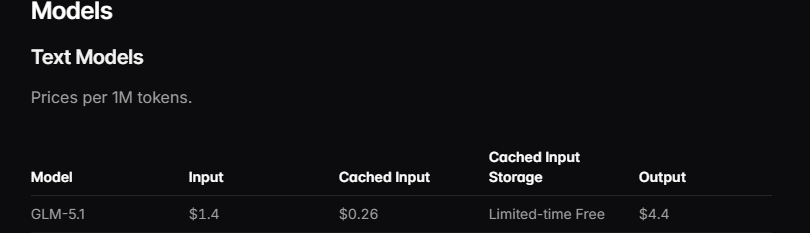
The GLM 5.1 model follows a much lower pricing policy compared to its competitors like OpenAI and Anthropic, and it doesn't compromise performance in the process. In other words, if you're looking for an LLM with a high price-performance ratio, GLM 5.1 is a model you should consider. The GLM 5.1's pricing:
- $1.4 per million input tokens
- $0.26 per million cached input tokens
- $4.4 per million output tokens
How to Access GLM 5.1?
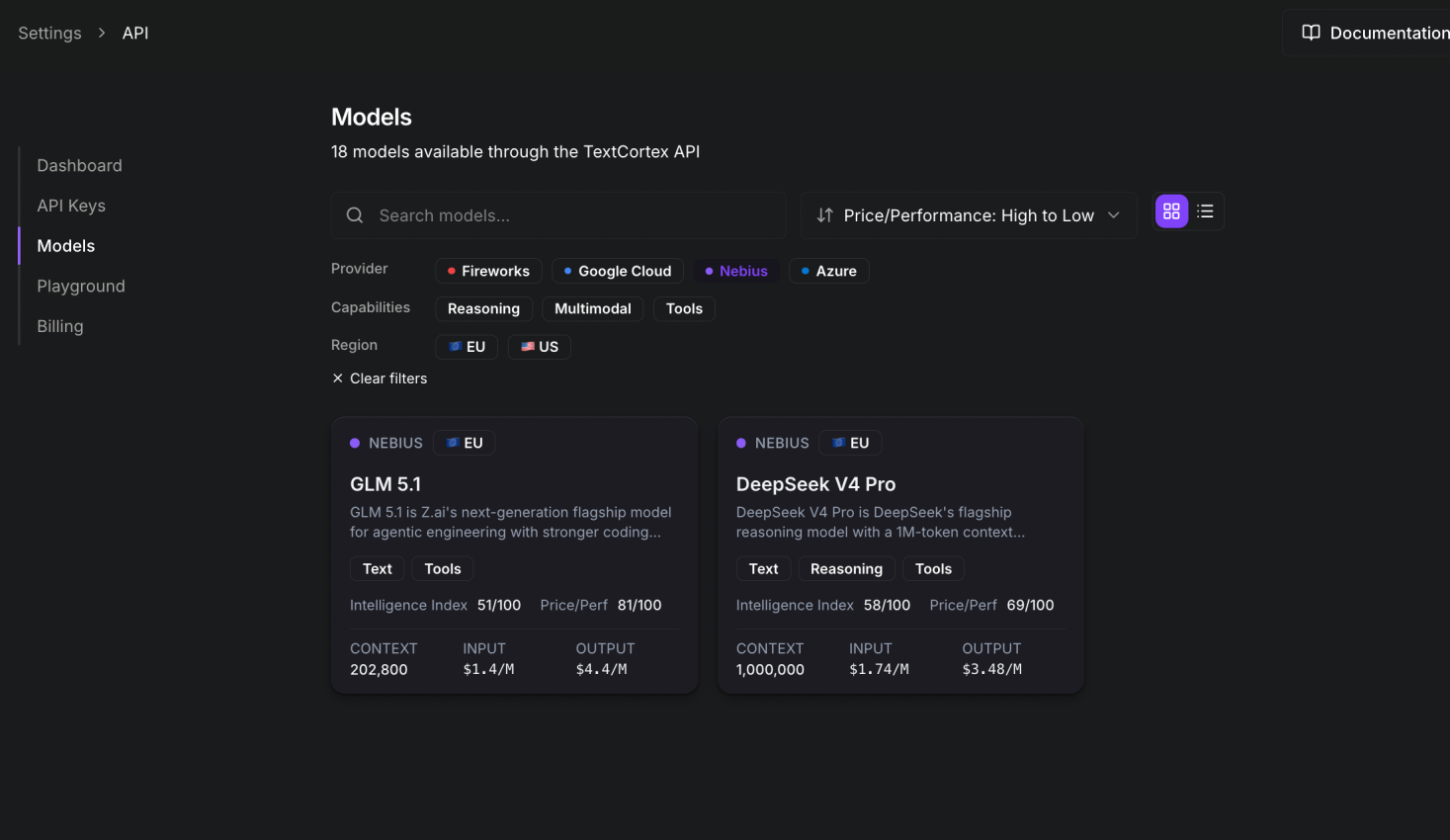
There are two main ways to access the GLM 5.1 model. The first is to experience it through the z.ai chatbot web application. In this method, all you need to do is create a z.ai account. The second way to access the GLM 5.1 model is to use it as an API. If you want to use the GLM 5.1 model directly as an API, you will need to use US or Chinese servers. Here is where the hidden third option comes in. If you want to use the GLM 5.1 model as EU-hosted and GDPR-compliant, TextCortex comes to your rescue. Thanks to TextCortex, you can access the GLM 5.1 model as both an AI chatbot and an API in an EU-hosted way.
GLM 5.1 Features & Capabilities
The GLM 5.1 model offers significantly more affordable pricing and better performance compared to the GPT-5.4 and Claude Opus 4.6 models. Let's take a closer look at the features and capabilities of the GLM 5.1.
Benchmark Performance
While benchmark performance of a large language model may not provide a completely accurate judgment about it, it is ideal for measuring its predictive performance. The GLM 5.1 model scores slightly below or outperforms GPT-5.4 and Claude Opus 4.6 in benchmarks like AIME 2026, GPQA-Diamond, and HLE, which are used to measure the reasoning performance of LLMs.
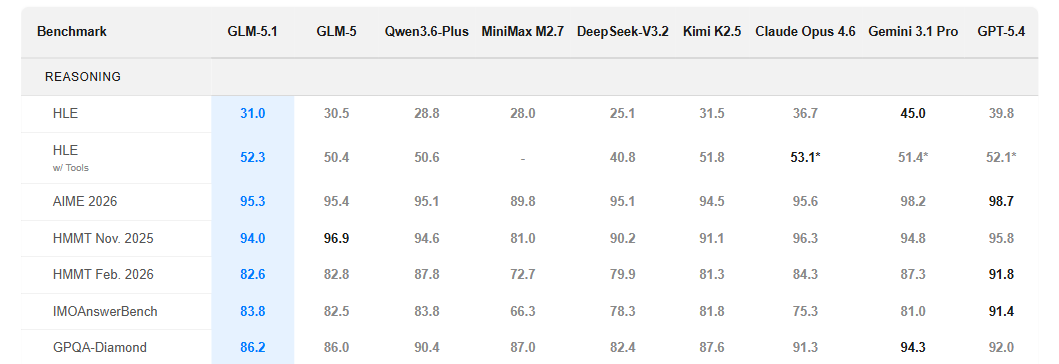
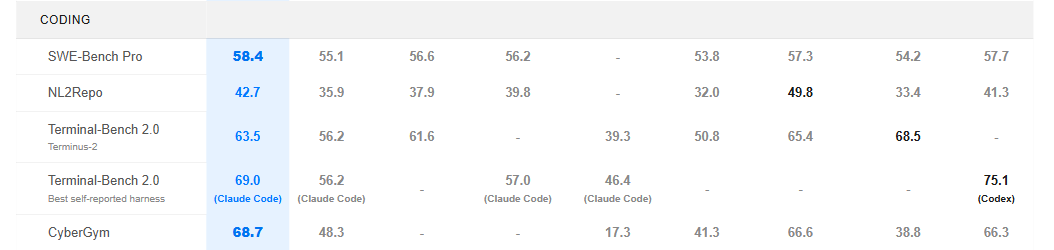
When it comes to coding performance, GLM 5.1 achieved a score of 58.4% in SWE-bench Pro, outperforming both GPT-5.4 and Claude Opus 4.6. Furthermore, GLM 5.1 ranks just behind its competitors in benchmarks like Terminal Bench 2.0.
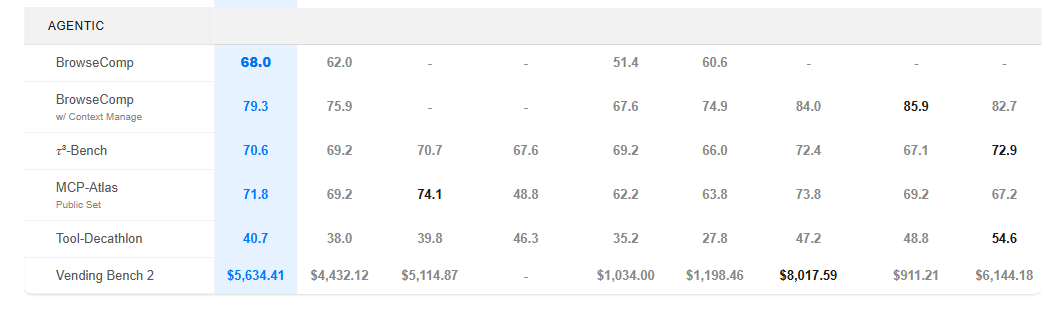
Looking at the agentic performance of the GLM 5.1 model, in the BrowseComp benchmark, the GLM 5.1 model outperforms its competitors, while in other benchmarks, such as MCP-Atlas, it lags just behind its rivals. The shining part is that the GLM 5.1 model offers all this performance at a much lower budget.
GLM 5.1 Features
The GLM 5.1 model offers its users 754 billion parameters. This value is close to frontier models like OpenAI, Google, and Claude. With its 754 billion parameters, the GLM 5.1 model aims to deliver high performance in tasks such as agentics, reasoning, coding, natural language, and data analysis. What's more, while most models with this parameter range are closed-source, the GLM 5.1 model is an open-weight option. The fact that the GLM 5.1 model is open-source and MIT licensed means it is accessible for commercial use. In other words, you can develop your own AI models using the GLM 5.1 model and use and market them without any restrictions. The GLM 5.1 model is also open to fine-tuning for your specific needs or purposes.
GLM 5.1 vs. GPT-5.4 and Opus 4.6
The GPT-5.4 model is a closed-source model that you can use via the OpenAI API, and similarly, the Opus 4.6 model can be used as closed-source within the Claude ecosystem via the Claude API. On the other hand, the GLM 5.1 model is completely open-weight, so you can integrate it into your own ecosystem and freely fine-tune it for your specific needs. If you want to access all these models through a single provider and choose the model according to your needs, TextCortex is the way to go.
TextCortex AI: Access GLM 5.1 API as EU-Hosted
If you want to use the GLM 5.1 model as an AI agent or AI chatbot, automate your complex workflows with GLM 5.1, or access the GLM 5.1 API in an EU-hosted, GDPR-compliant manner, TextCortex is the solution for you. TextCortex is a leading workflow automation, knowledge management, and EU-hosted LLM provider that aims to reduce the workload of enterprises and save them time. You can integrate TextCortex AI directly into your enterprise workflow, enhance your knowledge management game, automate repetitive and complex workflows, and use 18 different large language models with the TextCortex API.
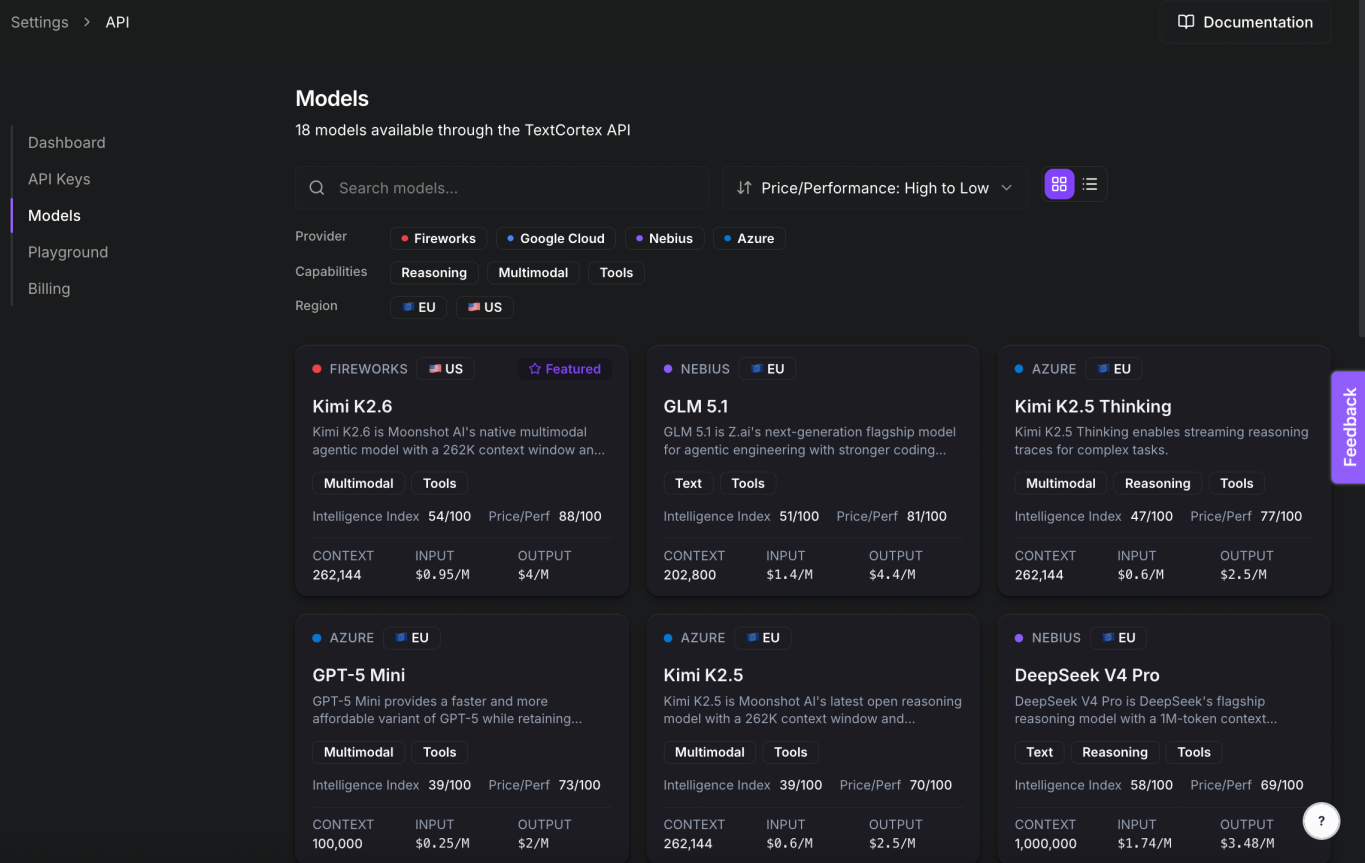
How to Access GLM 5.1 via TextCortex?
There are three ways to access the GLM 5.1 model via TextCortex. The first method is to head to the TextCortex web application, start a new chat, and select the model as GLM 5.1. The method for accessing and using the GLM 5.1 model for automation with TextCortex is to select the GLM 5.1 model as the default LLM for the AI agent. Once you head to the TextCortex web application, simply click the "create agent" button in the left menu and scroll down to set the default LLM option to GLM 5.1.
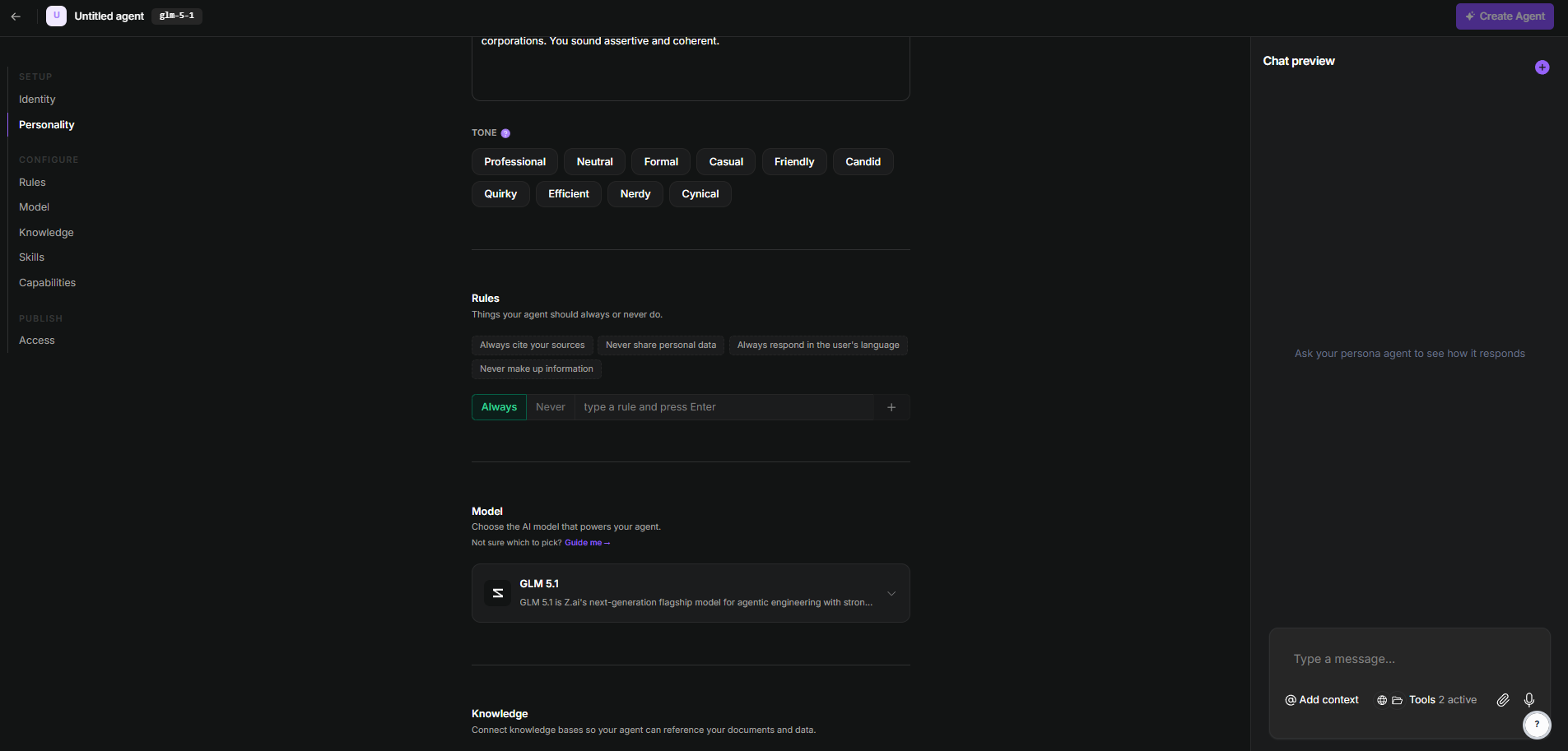
GLM 5.1 API as EU Hosted
If you want to use the GLM 5.1 API in an EU-hosted environment, TextCortex is the solution for you. With the TextCortex API, you can integrate the GLM 5.1 model into your own AI project and leverage an LLM that is much more affordable than GPT-5.4 or Opus 4.6, but offers similar performance.
Frequently Asked Questions
Is GLM 5.1 Chinese?
Yes, GLM 5.1 is a Chinese AI model. GLM 5.1 was developed by Z.ai (formerly Zhipu AI), a publicly traded Chinese AI lab.
What is GLM 5.1 AI?
GLM 5.1 is a large language model developed by Z.ai, capable of providing reliable productivity in complex tasks with powerful coding and reasoning capabilities.
Is GLM 5.1 Free?
No, you need to pay API pricing to use the GLM 5.1 model. However, GLM 5.1 offers much more affordable pricing compared to frontier models from OpenAI, Google, and Anthropic.
.png)
.png)
.png)