Artificial Intelligence (AI) models and tools continue to change the way we work and our daily lives. Like any new technological product, AI requires its own laws, regulations, and guidelines. Regulatory compliance includes frameworks and guidelines that AI companies must follow and implement. These rules are made by governments and organizations to prevent data leakage and to protect people from AI risks. If you're wondering what AI compliance is and how to comply with your AI models, we've got you covered!
TL;DR: AI regulatory compliance means following the rules, frameworks, and guidelines that apply when you build, deploy, and operate AI systems. AI compliance is critical for enterprises because AI systems access large volumes of internal data and can make workflow decisions, so compliance helps prevent data leakage, reduce critical errors, and enable logging/tracking of AI actions. AI compliance typically covers transparency, fairness, accountability, privacy, ethics, safety/security, and overall control and management of AI systems. Key regulations and frameworks to know include the EU AI Act, NIST AI Risk Management Framework, China's AI governance principles, GDPR, industry-specific rules like HIPAA, and international standards such as ISO/IEEE. Implementing compliance generally involves classifying AI use cases by risk, establishing governance roles and policies, running risk assessments, putting security controls in place, verifying vendor/tool compliance, and maintaining audit trails with continuous improvement. TextCortex offers its users knowledge management and workflow automation with an AI-compliant approach aligned with frameworks like the EU AI Act, GDPR, and ISO.
What is AI Regulatory Compliance?
AI regulatory compliance means following the rules, frameworks, and guidelines that apply when you build, deploy, and operate AI systems. These requirements are set by governments, regulators, and standards bodies to make sure AI is safe, secure, transparent, and fair. In practice, it's about turning high-level principles into real controls like documentation, testing, monitoring, and accountability so your AI works as intended and safe.
Why is AI Compliance Important for Enterprises?
The first and most important element of AI compliance is its ability to work with a large amount of internal or enterprise data. To ensure the security of your enterprise data, you need to ensure that AI systems comply with regulatory compliance requirements designed as security requirements. Secondly, because AI systems, especially AI agents and home automation tools, integrate with your enterprise workflow, they can make important decisions. By securing your AI systems, you can ensure that the models won't leak data or make incorrect decisions in critical situations. On top of that, AI compliance allows you to log, track, and manage all actions of AI systems.
What Does AI Compliance Cover?
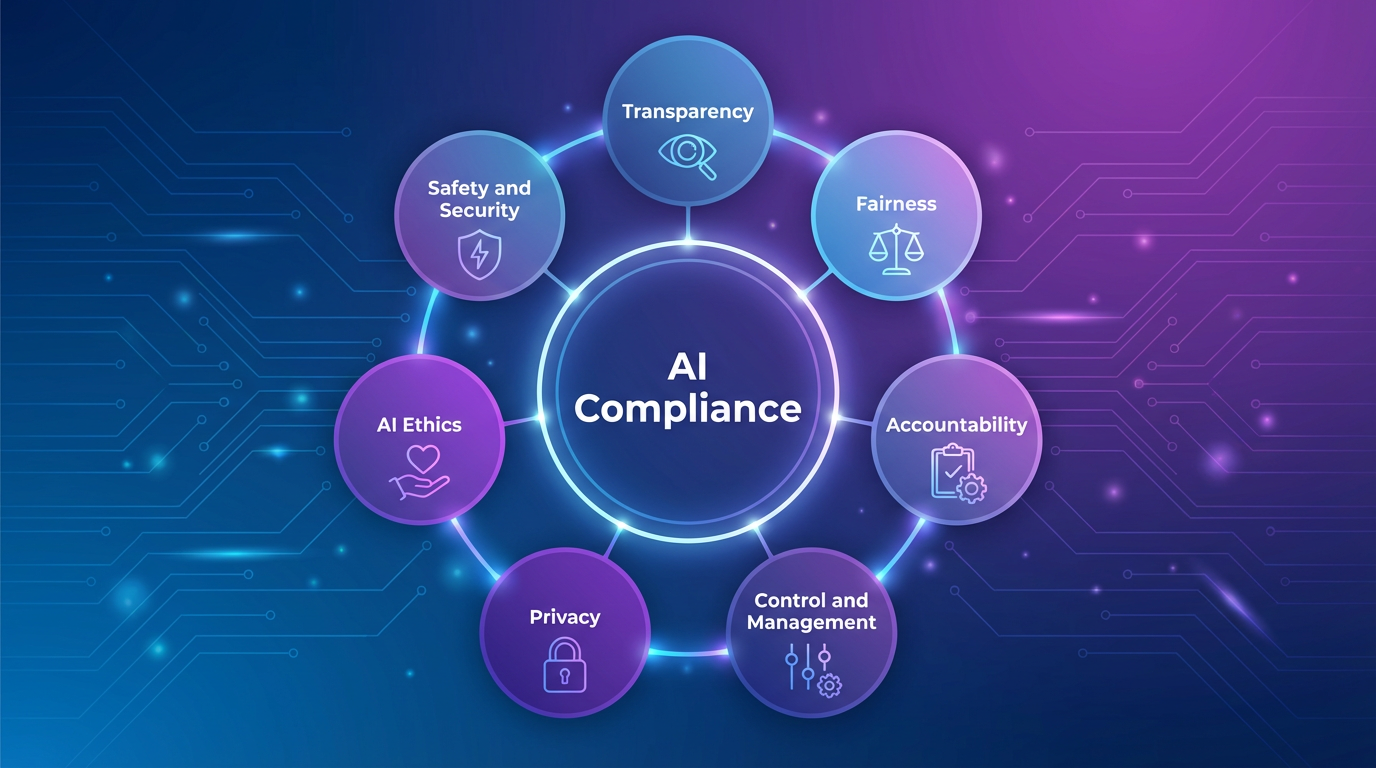
AI compliance ensures that the AI systems you use in your organization comply with regulations and rules, and mostly covers:
- Transparency
- Fairness
- Accountability
- Control and Management
- Privacy
- AI Ethics
- Safety and Security
The Most Popular AI Regulations and Frameworks
Different countries have different regulations and rules for AI systems. In addition to national regulations, there are also general data protection standards and frameworks such as GDPR. The most popular and effective AI regulations and frameworks that you need to know include:
- EU AI Act (European Union)
- NIST AI Risk Management Framework (United States)
- China's AI Governance Principles
- GDPR (General Data Protection Regulation)
- Industry-Specific Regulations (HIPAA)
- International Standard (ISO and IEEE)
AI Compliance 101: How to Implement AI Compliance?
Now that we understand AI regulations and rules, we can move on to the next step: integrating them into enterprise AI systems. While each AI regulation has different requirements, the steps to meet them are similar.
1. Classify AI Use Cases
The first step in AI compliance is to list the purposes for which you will use it. For example, you can use AI systems in chatbots, copilots, agents, or workflow automation. After listing the use cases for AI systems, you need to rank them according to their data access and decision-making capabilities. For example, AI systems that can make important decisions or access large amounts of your data carry high risks.
2. Establish Governance Policies
As a second stage, you need to define clear policies for data privacy and fair use of AI. Items that are valid for every organization include:
- AI Compliance Owner (policy + oversight)
- Business Owner (value + accountability)
- Security & Privacy (controls)
- Legal (regulatory interpretation + contracts)
- Model/ML Owner (technical quality + monitoring)
3. Risk Assessments
Before launching any AI system, identify its potential risks and take precautions. Map the use case to your regulations, then document likely failure models, the controls you'll use to mitigate them, and why you consider the remaining risks.
4. Put Security Controls
We recommend that you ensure you have completed the security controls before deploying a model. This stage is necessary for monitoring, observing, and controlling AI systems. The basic security control systems you can use are:
- Access controls
- Data lineage
- Prompt hygiene
- Data minimization
- PII (Personally Identifiable Information) handling
- Encryption
5. Vendor and Tool Compliance
If you are using external tools with different compliance requirements, you need to check features such as data usage terms, security posture, subprocessor transparency, right to audit, and compliance reporting. These checks are necessary to ensure the security of third-party tools.
6. Audit Trails and Continuously Improvement
AI system security and compliance aren't checklists that you complete once and never look back on. Evolving AI technology brings about changes in rules and compliance. Therefore, to ensure continued AI compliance, you must continuously train AI system security. To continuously monitor the security of AI systems, follow these steps:
- Role-based AI training
- Internal audits and logs
- Incident drills
- KPI (Key Performance Indicator) tracking
TextCortex: Compliant Enterprise AI Infrastructure
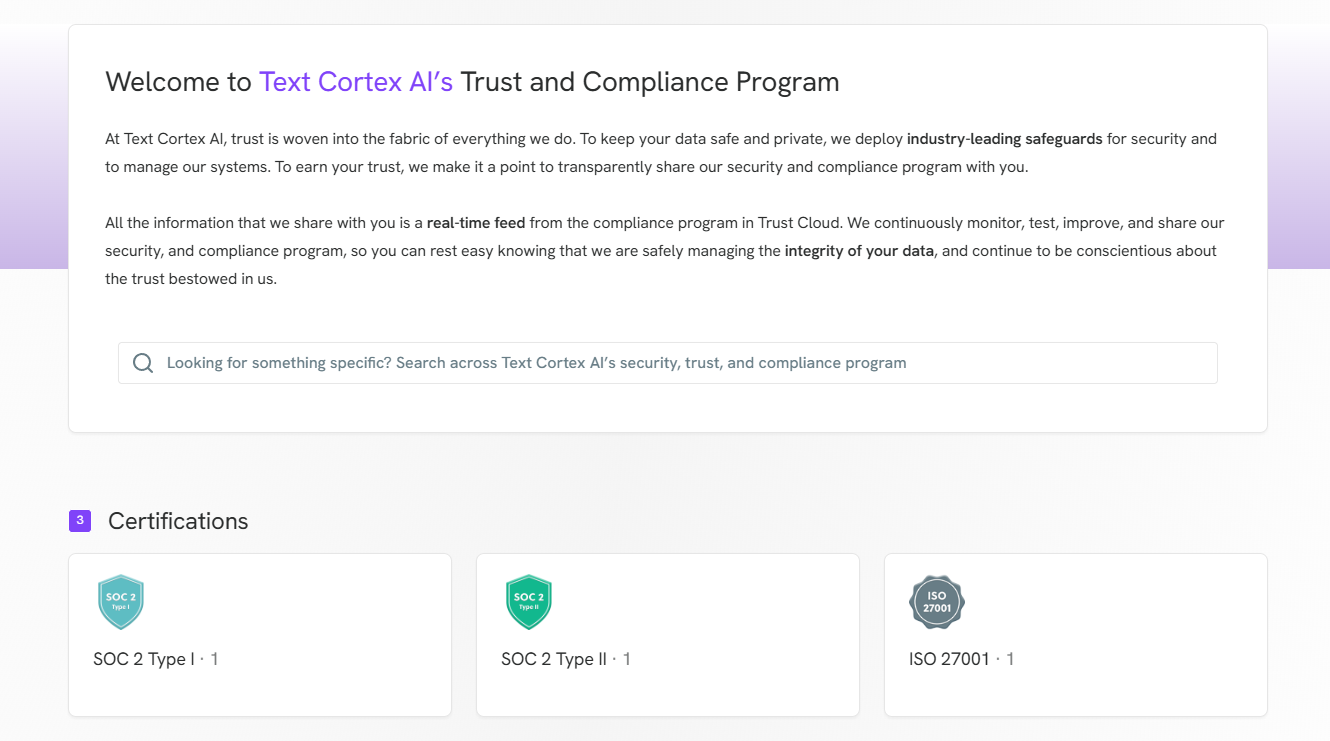
TextCortex is an EU-based enterprise AI infrastructure platform built for organizations that need to deploy AI agents on their own company data without compliance headaches. It provides multi-model access (GPT-4o, Claude, Gemini) from one secure, EU-hosted environment, with full compliance across the EU AI Act, GDPR, ISO 27001, and SOC 2. You can review the full security posture at trust.textcortex.com.
TextCortex Enterprise AI Solutions
TextCortex offers workflow automation and knowledge management features for enterprise users. With TextCortex, you can upload or connect your internal databases as a knowledge base and generate output using your databases. For example, by integrating customer support tickets into TextCortex, you can analyze the most frequently asked questions and the most common problems, and generate guides for each issue.
Another feature offered by TextCortex is the AI agent framework. With TextCortex, you can build AI agents for your specific or repetitive tasks and automate your workflows. Regardless of the department, there are tasks in every area of your work that you can automate or facilitate with AI. You just need to discover how to use AI.
Atares deployed TextCortex and now saves 20 hours per week on content and productivity workflows, with full compliance maintained throughout. Read the case study here.
Frequently Asked Questions
What is AI compliance?
AI compliance refers to the processes, guidelines, policies, and frameworks that ensure AI models operate ethically, legally, and safely. For example, TextCortex protects your data in compliance with regulations such as the EU AI Act and GDPR.
Why is AI compliance important?
The fundamental reason AI compliance is important is that to use AI systems in your region, you need to make them compliant with your regional laws. If AI systems aren't compliant with your regional regulations, you can't reap their benefits and integrate them into your workflow.
What certifications should an AI vendor have?
At minimum, look for ISO 27001 (information security management), SOC 2 Type II (ongoing security controls), GDPR compliance (if you operate in or serve EU citizens), and EU AI Act alignment. These certifications signal that the vendor treats security as a continuous process, not a one-time checkbox.
How to implement AI governance?
To implement AI governance in your enterprise:
- Classify AI use cases for your organization
- Establish governance policies
- Do risk assessments
- Put security controls
- Check vendor and tool compliances
- Audit trails and continuously improve your AI security
.png)
.png)
.png)