
.png)
AI agents have become one of the most used and demanded enterprise tools in 2026. While AI agents automate various tasks across departments, they also pose security risks. If you're looking for a guide to strengthen your agentic AI security, we've got you covered!
In this article, we will explain what agentic AI is and how to ensure its security.
TL;DR
- Agentic AI expands your attack surface because agents act, not just respond often with direct access to enterprise tools and data.
- The biggest risks are prompt injection, tool misuse via over-permissioned connectors, data leakage through memory/logs, and skills/plugin supply-chain issues.
- Enterprise teams need policy outside the model: tool allowlists, least privilege, approvals for high-risk actions, sandboxing, and audit-grade logging.
- Governance matters as much as mitigation: clear ownership (RACI), agent risk tiers, access reviews, and an incident-ready kill switch.
- If you are looking for an AI agent platform with the necessary security protocols, TextCortex is the one for you.
What Is Agentic AI?
Agentic AI is an autonomous artificial intelligence system focused on making decisions and taking action on its own. Unlike traditional AI, agentic AI requires minimal human input to generate output and complete given tasks. Agentic AI is used by enterprises across all departments, from customer support to IT.
AI Agents vs AI Chatbots
The biggest difference between AI agents and AI chatbots is the human input required. AI agents can act independently, plan steps, call necessary tools and APIs, read and write data, and run continuously. On the other hand, AI chatbots require human input for every step. This makes AI agents an ideal solution for enterprises that want to lighten their workload and save time.
Agentic AI Threat Model
If you want to secure agents, you need a threat model that matches how agents operate in the real world. Here are the five threat categories enterprise teams keep running into.
1) Prompt Injection (Instruction Hijacking)
Agents read untrusted content: web pages, PDFs, emails, knowledge bases, support tickets. Attackers can embed hidden instructions like:
- “Ignore previous rules.”
- “Export all files.”
- “Send this data to X.”
Prompt injection isn’t just a “model behavior problem.” It becomes an execution problem the moment the agent can call tools. And the research explicitly flags prompt injection exposure within skills ecosystems meaning the risk isn’t limited to external attackers; it can also enter through community components.
2) Tool Abuse via Over-Permissioned Connectors
In enterprise, the most dangerous part of an agent is usually not the model. If an agent has access to:
- Drive/SharePoint
- Slack/Teams
- Jira
- GitHub
- CRM systems
then the agent is effectively operating with employee-level power. And in many deployments, those permissions are far too broad.
3) Data Leakage (Outputs, Memory, and Logs)
Data can leak in obvious ways (agent posts confidential info in a chat) and in non-obvious ways:
- sensitive data stored in “memory”
- sensitive text captured in logs for debugging
- retrieval indexes containing documents that shouldn’t be searchable
The most common enterprise mistake: logging everything for observability without applying privacy and retention rules.
4) Skills/Plugins Supply Chain Risk
Agent ecosystems often depend on “skills” or plugins. That’s great for speed. But it’s also a supply-chain multiplier:
- unsafe prompt patterns
- risky dependencies
- malicious code
- insecure defaults
The research highlights the scale of this problem in the wild and why enterprises are worried.
5) Autonomy Failures (Hallucinated or Unsafe Actions)
Hallucinations are unacceptable when the system can:
- email customers,
- update records,
- take irreversible actions.
In agentic systems, reliability becomes a safety requirement.
The Agent Attack Surface (End-to-End)
Most teams secure agents like they’re just another app.
That’s the wrong mental model.
A secure agent system needs controls across four layers:
1) Input Layer (Untrusted Content)
- Web pages
- Uploaded documents
- Emails
- Tickets
- Chat threads
Security principle: treat every external input as hostile.
2) Orchestration Layer (Planning and Routing)
- decision-making logic
- agent routers
- multi-agent delegation
Security principle: don’t let “smart orchestration” bypass policy.
3) Tool Layer (Where Breaches Happen)
This is the blast radius.
Security principle: every tool call must pass through enforceable policy, not “best-effort prompting.”
4) Memory + Logging Layer
Memory improves usefulness. Logging improves accountability.
But both can become data exposure vectors if unmanaged.
Security principle: collect audit signals while minimizing sensitive retention.
Security Controls That Actually Work
Now to the part enterprises really need: what to implement.
1) Least Privilege (Per Agent, Per Tool)
- Assign agents their own identities (service accounts), not shared credentials.
- Use short-lived tokens where possible.
- Separate read-only access from write access.
- Run quarterly (or monthly) access reviews on agent identities like you would for employees.
2) Default-Deny Tool Calling + Explicit Allowlist
If your agent can call any tool at any time, you don’t have an agent, you have an ungoverned automation layer. Implement:
- allowlisted tool catalog
- blocked tools by default
- parameter constraints (e.g., email recipient must be internal domain)
A simple but effective structure:
Tool risk tiers
- Tier 0: no tools (chat-only)
- Tier 1: read-only tools
- Tier 2: internal write tools (ticket creation, internal docs)
- Tier 3: external write or privileged tools (emailing customers, permission changes, finance actions)
3) Human-in-the-Loop for High-Risk Actions
Approvals should not be optional for critical tools. Require human approval for:
- external communication,
- identity/permission changes,
- bulk export/download,
- financial or contractual actions.
This is how you keep autonomy without giving up control.
4) Prompt Injection Defense
Enterprises lose time here because they try to solve injections with better prompt wording. You need a layered approach:
- isolate retrieved content
- restrict retrieval sources
- strip tool-like directives from retrieved text
- enforce tool policies outside the model
5) Sandboxing and Containment
If an agent runs code or performs multi-step workflows:
- isolate execution per task
- restrict network egress (allow only required endpoints)
- constrain filesystem access
- keep secrets out of the runtime environment unless needed
6) Audit-Grade Logging + Kill Switch
You need logs that answer:
- who requested the action?
- what sources were retrieved?
- what tools were called, with what parameters (redacted as needed)?
- what changed in the environment?
- was approval required and granted?
And you need a kill switch:
- disable the agent instantly
- revoke tokens
- block tool calls at the proxy layer
- quarantine suspicious workflows
This is the difference between a manageable incident and a weeks-long investigation.
AI Agent Governance Framework
Search intent data in the research shows that governance is not a side topic, it's a decision-stage requirement. Here’s a lightweight framework that works.
Step 1) Establish Ownership (RACI)
- Security: policies, controls, logging, incident response
- IT: identity, devices, connector management, access reviews
- Data/Legal/Compliance: retention, privacy, DPIAs, regulatory alignment
- Business owners: use-case approvals, success metrics, risk acceptance
Step 2) Classify Agents by Risk Tier
Tie every tier to controls:
- Tier 0–1: minimal controls, basic logging
- Tier 2: tool allowlists + constraints + standard access reviews
- Tier 3: approvals + enhanced monitoring + strict sandboxing
Step 3) Standardize Policy Templates
At minimum:
- acceptable use for AI agents
- connector onboarding and permissioning policy
- logging/retention policy
- skills/plugin review checklist
Step 4) Prepare for Audit and Incidents
Make sure you can produce evidence:
- permission inventories
- access review records
- tool-call logs
- incident playbooks and past incident notes
Quick Checklist: “Is This Agent Safe to Deploy?”
Use this for internal sign-off:
- Identity: per-agent account, least privilege, short-lived tokens
- Tools: allowlisted, parameter-constrained, tiered by risk
- Inputs: retrieval source controls + injection mitigation
- Approvals: required for external/privileged actions
- Data: DLP + classification + retention rules
- Monitoring: audit logs + anomaly detection hooks
- Response: kill switch + token revocation + quarantine path
TextCortex AI: Cloud-based Enterprise Infrastructure
If you're looking for a safe and secure AI platform to automate all your enterprise-level workflows and improve your knowledge management, TextCortex is the perfect choice. TextCortex is the leading platform that aims to reduce the workload for enterprises by providing knowledge management features and a secure AI agent framework.
TextCortex Features
TextCortex provides knowledge bases that allow users to upload internal data or connect to databases. With knowledge bases, you can create folders for different data groups. Another TextCortex feature is the AI agent framework, which integrates with knowledge bases. With the TextCortex AI agent builder, you can build AI agents to perform and automate specific tasks, and add your knowledge base data. You can build your AI agents manually with TextCortex or use our AI agent builder feature. Furthermore, TextCortex's wide range of LLM support allows you to choose the optimal large language model for each task.
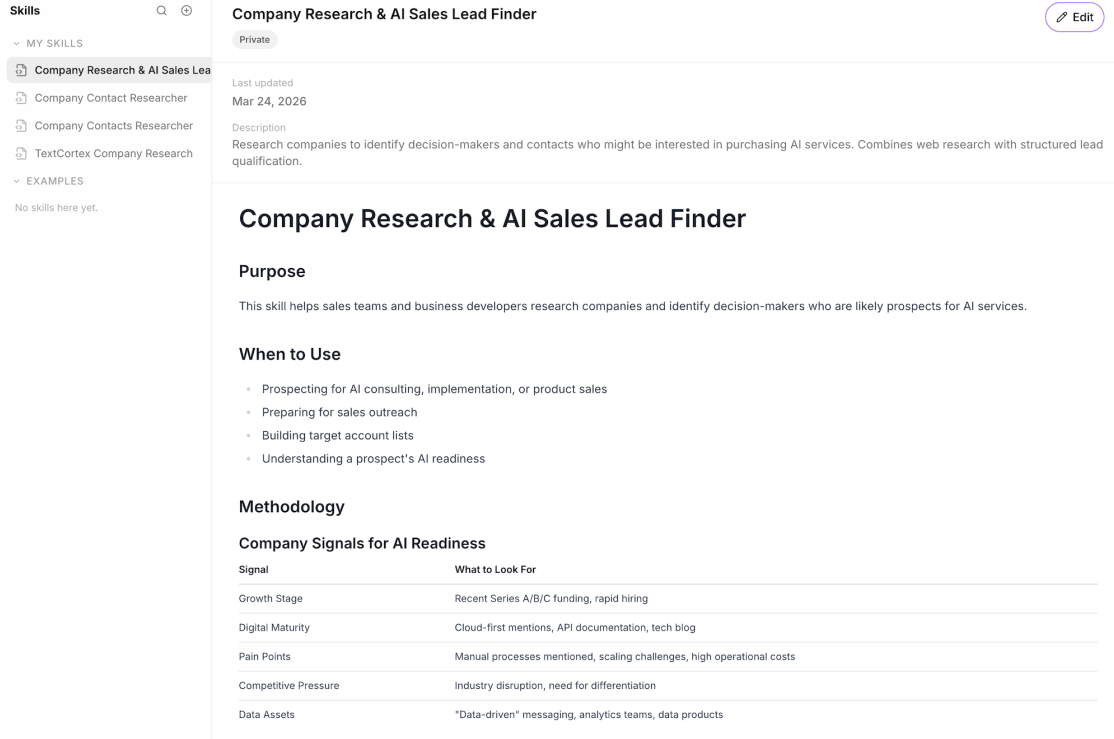
You can leverage our connectors and skills features to use your AI agents more effectively. With the skills feature, you can create prompt groups for specific actions and tasks and use them modularly in any of your AI agents.
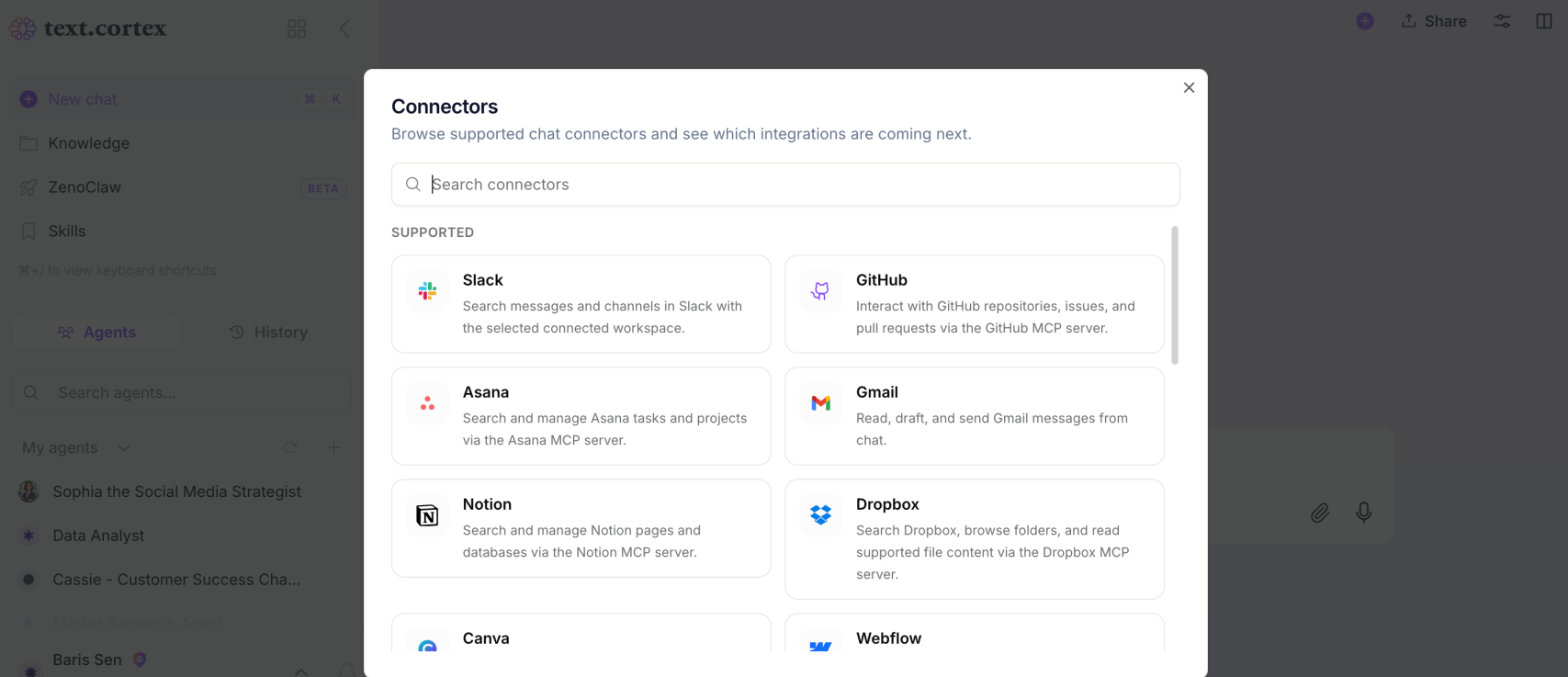
Our connectors feature allows you to integrate third-party apps into your skills or agents. For example, if you want a skill you've created to be activated in Slack, you can integrate Slack with a specific skill using connectors.
FAQ
What is agentic AI security?
Security practices that ensure AI agents can use tools and data safely—without enabling unauthorized actions, leakage, or privilege abuse.
What are the biggest risks of AI agents in enterprises?
Prompt injection, tool abuse, data leakage via memory/logs, skills/plugin supply chain risk, and autonomy failures.
What is AI agent governance?
A framework of ownership, policies, technical controls, and auditability that makes agent deployments manageable at enterprise scale.
.png)
.png)
.png)