.png)
Generative AI technology has effective, time-saving, and productivity-enhancing applications in the Mergers and Acquisitions (M&A) sector, as it does in every field and industry. AI technology provides benefits for M&A through web search, data analysis, document analysis, and automation options. If you own an M&A firm and are wondering how you can get more value using AI technology, we’ve got you covered!
In this article, we will explore what AI is in M&A and the use cases of AI for M&A firms.
TL; DR
Generative AI helps M&A firms save time, cut costs, and boost productivity across the entire deal lifecycle. Key use cases include target identification and sourcing (monitoring market signals, assessing cultural and operational fit), enhanced due diligence (contract analysis, risk identification, financial review, compliance checks, anomaly detection), valuation and deal structuring (scenario modeling, risk/ROI estimation, timing optimization), negotiation support (historical deal analysis, clause suggestions), regulatory compliance (multi-jurisdiction screening and real-time change tracking), communication and collaboration (onboarding docs, workload tracking, language support), personal AI assistants, and cross-department automation. TextCortex supports all of these with knowledge bases, web access, customizable AI agents, and multiple LLMs, helping firms like Atares save up to 20 hours per user per week.
What is AI in M&A?
Generative AI technology is a product that can create new and unique content and data based on large databases and given databases. Generative AI not only generates content but can also analyze existing content and documents, collect data on specific types and topics from the internet, and transform raw data into insights. All these features of AI make it an effective automation and workflow streamlining tool for M&A. It is possible to use artificial intelligence technology in all stages of M&A, from due diligence to cultural integration.
Benefits of AI in M&A
The biggest and most important benefit of AI for Mergers and Acquisitions (M&A) is time savings. With AI, you can speed up or even automate almost all M&A tasks, such as document analysis, client analysis, contract review, market research, target identification, and due diligence. Another benefit of AI for M&A is time savings. The M&A process often requires analyzing hundreds of documents and extracting large amounts of data. AI can reduce this process from weeks to hours, saving you significant time. For example, Atares (a leading M&A firm) uses TextCortex AI to save up to 20 hours per user per week on M&A tasks.
Use Cases of AI in M&A
If you're wondering about the uses of AI in M&A and which tasks it can help with, we've prepared a list for you. By reviewing this list, you can learn how AI can make tasks easier for you.
Target Identification and Sourcing
Analyzing market data and identifying potential acquisition targets has always been a challenging, mundane, and error-prone task. Finding targets with strong financial performance, growth potential, and suitability that meet specific criteria can be particularly difficult. Fortunately, AI tools, with their machine learning and natural language processing capabilities, offer an effective solution for understanding the patterns you define for target identification, tracking market patterns, and capturing opportunities missed by human analysis.
You can build AI agents that monitor news, social media platforms, industry publications, newspaper clippings, and company financial or strategic announcements. These AI agents can track company developments for you and provide early signals about potential targets. This allows you to track potential targets early and send offers quickly. What’s more, AI also assesses compatibility between potential partners by analyzing corporate cultures, customer logs, customer bases, and operational alignments to reduce the risk of integration problems after the deal closes.
Enhancing Due Diligence
AI is the ideal solution for accelerating and enhancing due diligence processes thanks to both its data analysis capabilities and automation capabilities. Initially, you can use AI for due diligence to speed up and automate repetitive and demanding tasks like contract review and data analysis. AI tools analyze given data according to desired commands and criteria and are much faster than humans. Furthermore, AI includes even the smallest data fragments that might be overlooked in manual analysis. You can either manually input data analysis to the AI or automate it with AI agents that integrate with your databases, such as TextCortex. After the AI processes the data analysis for you, it's up to you to double-check and evaluate the outputs to make the final decision. Here are some of the tasks you can use AI for due diligence:
- 계약 분석
- Risk Identification
- Financial Statement Review
- Compliance Verification
- Property Assassination
- Environmental, social, and governance (ESG) Evaluation
- Data Analysis Automation
- Data Search
- Culture Analysis
- Revenue Quality Patterns
- Anomaly Detection
- Contract Clauses
Valuation, Deal Structuring and Negotiation
Once you gather all the information and insights from due diligence, it's time to proceed with valuation, deal structuring, and negotiation. AI, as in previous stages, is a perfect fit to assist you in this phase, lightening your workload and saving you time, allowing you to focus on more critical issues. AI can quickly incorporate more variables and process alternative scenarios, leading to accelerated and enhanced valuation. Machine learning algorithms and AI models, offering AI agent frameworks like TextCortex, where you can define your own parameters and rules, can analyze a wide range of data, from historical transaction data to pricing patterns, to produce final outputs that will assist you in the decision-making process. Furthermore, thanks to AI's predictive analytics, you can make strong predictions about how different terms in the negotiation process will affect post-merger performance. What's more, AI can help you determine the optimal timing for deal announcements based on market conditions and competitor activities. AI assists in valuation, deal structuring, and negotiation by:
- Processing your unstructured data
- Monitoring market conditions with real-time data analysis
- Identifying industry-specific risk factors
- Creating accurate strategies
- Estimating potential risks and ROIs
Negotiation Support
AI helps you not only with valuation assessment but also strengthens your negotiating position. AI systems can analyze historical deal data and generate potential scenarios to enable M&A teams to develop more effective and accurate negotiation strategies. AI systems can predict potential outcomes based on similar post-transaction cases, giving negotiators valuable insights.
Furthermore, AI models can analyze contract terms and list modification suggestions that prioritize company objectives. Of course, these results will not be your final adjustments; it is up to the negotiators to decide whether to implement or modify the outputs and suggestions generated by the AI. However, thanks to the power of AI, negotiators can quickly identify problematic clauses.
규정 준수
One of the most critical aspects of Mergers and acquisitions is ensuring both companies meet regulatory compliance requirements or possess the criteria to achieve them. You can automatically screen regulatory issues across multiple jurisdictions with a dedicated AI. AI algorithms can review thousands of documents to identify potential compliance issues and market concentration problems that might trigger regulatory scrutiny. AI platforms' compliance monitoring systems can track regulatory changes in real-time for both the target company and your company, ensuring deals remain compliant until the execution phase.
커뮤니케이션 및 협업
AI is a great solution not only for strengthening the M&A process but also for enhancing subsequent communication and collaboration. In a merger of two companies, you can use AI to create specific and customized onboarding documents after analyzing both companies, helping new employees adapt to the work culture. Furthermore, AI tools can track employee workloads and to-do lists, assign employee-specific tasks, and boost collaborative work. What's more, if your company has multinational employees, AI tools can eliminate language barriers, allowing everyone to find common ground.
개인 AI 비서
You can provide personalized AI assistants that can generate output using data from both companies to lighten your employees' workload and enable them to achieve results much faster. AI can analyze data to accelerate processes in simple and complex tasks, help employees quickly find the information they need, and complete repetitive tasks much faster and more efficiently.
Automation Across Departments
AI agents allow you to automate all repetitive tasks, from deal management to due diligence, saving time and costs. AI agents are ideal solutions for automating given tasks and saving time. You can build specific AI agents for any repetitive task, from data analysis to email writing. For example, the TextCortex AI agent framework allows you to specifically define any parameters you want, from the agent's behavior to the databases it will use.
TextCortex AI: Empower M&A with AI
If you're looking for a company AI assistant platform that supports all your M&A tasks and processes, from automation to market research, TextCortex is the solution for you. TextCortex offers users critical M&A features such as automation, web search, data analysis, document creation, and knowledge management. Furthermore, TextCortex provides a wide range of large language models to choose from depending on the complexity of your tasks. This allows you to select specific LLMs for your M&A tasks, balancing cost and efficiency.
Data Management and Data Analysis
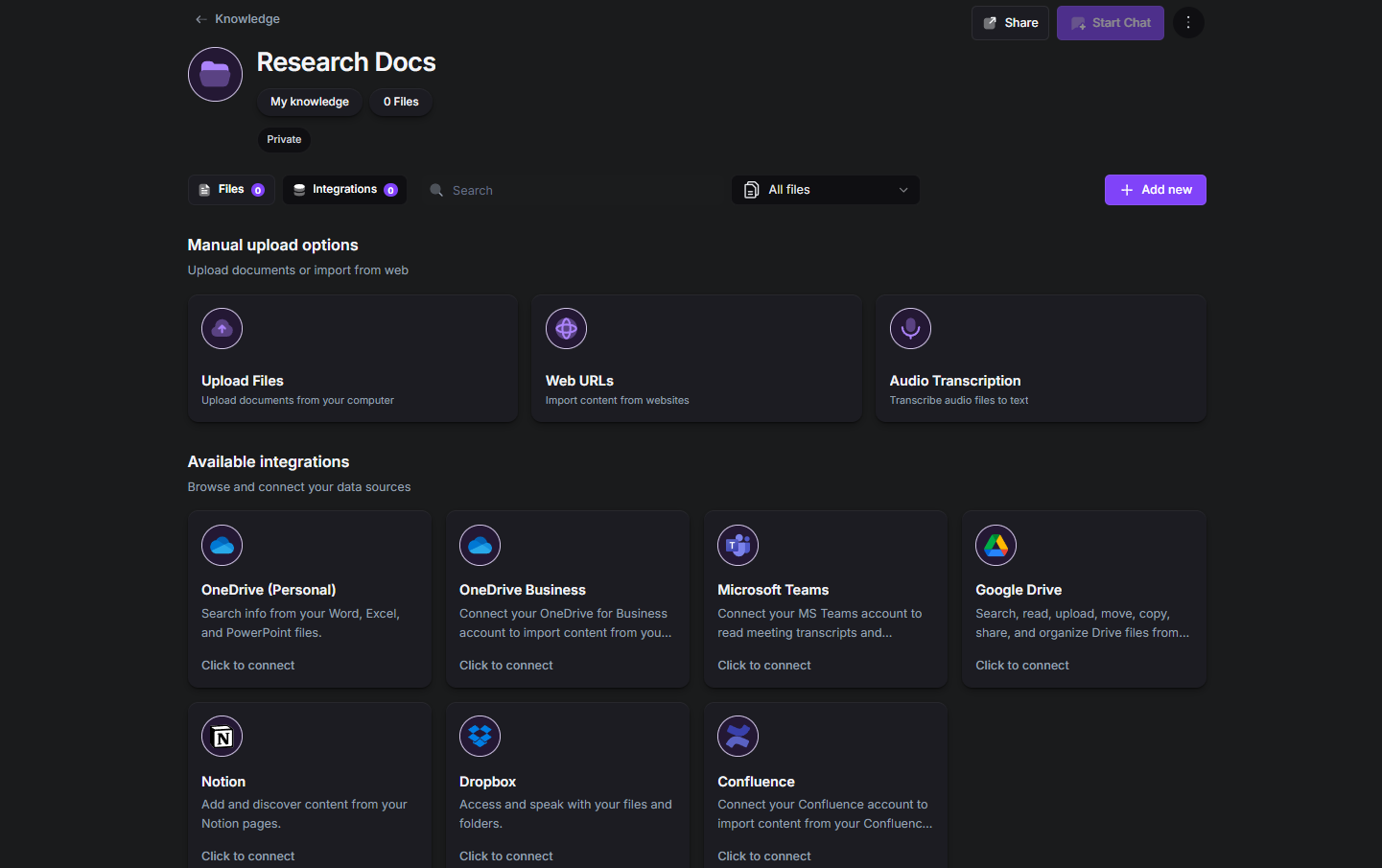
TextCortex knowledge bases allow you to analyze the databases you upload or connect to, turning your raw data into insightful information. You can upload documents manually to TextCortex or connect databases like Google Drive, OneDrive, Slack, and Notion with a single click. Afterward, you can automate a wide range of data-related tasks, from target identification to dataset processing, saving you time. For example, Atares saves up to 20 hours per employee per week by automating data-related tasks and enhancing knowledge management with TextCortex.
Market Research and Web Access
TextCortex web access allows you to automate tasks requiring real-time online data, such as market mapping, cold outreach, and market monitoring. By combining both internet data and your own data, TextCortex processes even the smallest details that might otherwise escape human attention, maximizing your research quality.
Custom Workflow Automations
TextCortex shines with its highly customizable automation capabilities. With TextCortex, you can automate a wide range of deal sourcing tasks, from simple tasks like cold outreach email/message writing to complex tasks with multiple steps, such as data enrichment. TextCortex already offers AI agents optimized for different tasks. However, with the TextCortex AI agent framework, you can build AI agents that you can customize for your specific tasks, from the default large language model to databases. You can complete the entire process manually or using our AI-powered agent builder.
자주 묻는 질문
How is AI used in mergers and acquisitions?
AI is used in mergers and acquisitions (M&A) for:
- Target identification
- Enhancing due diligence
- Negotiation support
- Valuation & Deal structuring
- Communication & collaboration enhancement
- Personal AI assistant
- Regulatory compliance check
- 자동화
- 데이터 분석
How does generative AI speed up due diligence?
Generative AI accelerates due diligence by offering features such as automation, fast and accurate data analysis, turning given data into insights, web search, and AI search.
Can AI do contract review in M&A?
One way to use AI in M&A is to complete contract reviews with it. AI tools can review contracts according to given criteria and standards and output the results.
.png)
.png)
.png)