.png)
Generative AI sets new standards and speeds up due diligence with its automation, data analysis capabilities, and data processing. According to Bain’s research, one in five M&A companies uses generative AI. Completing the due diligence process manually is a long and arduous process. Generative AI technologies can shorten this process and increase data processing efficiency. In particular, generative AI's ability to process data, collect data, access the web, analyze documents, quickly turn raw data into insights, process different types of documents as input and output, automate repetitive tasks, and complete complex tasks much faster makes it a gem for due diligence. If you're wondering what Generative AI is in due diligence and its advantages, we've got you covered!
In this article, we will cover the impact of Generative AI on due diligence and the advantages it provides.
TL; DR
Generative AI is reshaping M&A due diligence by automating document review, flagging risks, and turning raw data into actionable insights faster. One in five M&A firms already use it, and professionals report 40-50% faster completion rates. Key use cases include data room triage, contract analysis, red-flag detection, financial anomaly scanning, compliance mapping, synergy extraction, market synthesis, multilingual review, Q&A over documents, and first-draft reporting. Main advantages are end-to-end deployment through enterprise platforms, customizability for specific workflows, scalability and speed, automation with consistent output, and faster data/document analysis and drafting. Risks include hallucination, weak audit trails, data security concerns, and poor data quality. TextCortex addresses these with AI agents, knowledge bases, and web access: it connects databases like Google Drive, OneDrive, Slack, and Notion, automates data analysis and market research, and builds custom workflows for due diligence. M&A advisory firm Atares saves up to 20 hours per user per week using TextCortex.
What is Generative AI in Due Diligence?
Generative AI in due diligence refers to the use of artificial intelligence tools to provide value in various stages of due diligence, from contract review to risk flagging. For example, with Generative AI, you can analyze contracts much more effectively, process multiple contracts simultaneously, and generate insights about contracts. Another example is that thanks to Generative AI, you can automate tasks such as market research and risk analysis, and even save time by automating the generation of separate analysis documents and insights for each contract or potential target using AI agents. According to McKinsey's article, 40% of M&A professionals using Generative AI stated that they completed their work 40-50% faster.
How Generative AI is Used in Due Diligence
- Data room triage: condensing and organizing large document sets into clear priorities for review teams.
- Contract analysis: pulling out and benchmarking key provisions like change-of-control, assignment, exclusivity, and termination across many agreements.
- Red-flag detection: highlighting gaps, contradictions, and atypical clauses throughout the uploaded materials.
- Financial anomaly detection: scanning revenue, margin, and working capital trends for outliers that warrant deeper review.
- Regulatory and compliance scan: mapping permits, licenses, and litigation exposure against jurisdictional requirements.
- Synergy and integration mapping: extracting organizational, IT, and operational data to flag integration risks and opportunities.
- Market and competitor synthesis: pulling together public filings, news, and research to contextualize the target's position.
- Multilingual document review: translating and summarizing foreign-language contracts and filings without losing legal nuance.
- Q&A over the data room: responding to targeted questions ("which customer relationships carry the most concentration risk?") and pointing back to the underlying documents.
- First-draft outputs: producing initial versions of investment committee memos and risk briefs for people to polish and finalize.
GenAI Risks in M&A
While the speed and efficiency that Generative AI provides to M&A and due diligence are beneficial, they also come with their own risks. The most common generative AI risks include:
- Hallucination: Answers that are not supported by documents or data.
- No Audit Trail: If you are not using a GDPR-compliant AI platform, you cannot be sure of audit tracking.
- Data Security: If you are not sure your data is secure, remove the AI platform from your list.
- Data Quality: Opt for platforms that use the data you need, rather than the databases you provide.
Advantages of Generative AI in Due Diligence
Generative AI technology offers benefits that can be used by every sector, and due diligence & M&A are no exception. Let’s take a closer look at the advantages of generative AI in due diligence together.
End to End Solution
If you use generative AI tools in isolation, you can only speed up certain tasks and won't achieve the desired results. However, enterprise-focused AI platforms like TextCortex allow you to simplify the AI implementation process and deploy AI solutions more effectively. This way, you can seamlessly deploy generative AI to your enterprise, start using it quickly, and lighten your workload.
Customizability
Generative AI platforms offer customizable solutions that address enterprises’ specific needs, use cases, goals, and business processes. This allows you to clearly define the purposes for which you will use generative AI and track the value it provides much faster. For example, if your business is due diligence-focused, your AI solutions should be focused on accelerating, improving efficiency, and automating due diligence processes.
Scalability and Speed
Generative AI is adaptable for enterprises of various sizes, from large to small. You can customize your generative AI strategy according to your business needs. Moreover, once you set up generative AI for your enterprise, you will notice that complex, repetitive, or multi-step tasks are completed much faster. Thanks to the speed of generative AI output generation and data analysis, your employees will save time by completing tasks much faster.
Automation and Consistency
Generative AI is an effective solution for automating repetitive due diligence tasks. From document analysis and report comparison to market research, you can automate a wide range of due diligence tasks with generative AI. Furthermore, dedicated AI agents ensure that the automated tasks always produce consistent output. For example, an AI agent that continuously checks documents against the same criteria can make document insight generation continuous and consistent.
Data / Document Analysis
Generative AI is an effective tool for due diligence, particularly in simplifying the work of analysts. Instead of examining dozens of documents and databases one by one, analysts can quickly complete the analyses they need using generative AI. Specifically, by adding parameters and must/must-do lists to prompts or the AI agent's creation process, they can accelerate a wide range of analyses, from specific cases to generic data analysis.
Drafting & Documentation
Generative AI is excellent not only for analysis but also for processing given inputs and data to draft the documents you need. For example, to conduct competitive analysis or risk & value comparisons, you can input your databases into generative AI tools and have them generate the desired documents.
TextCortex: All-in-One AI Solution
TextCortex can enhance due diligence and save you time with its various features such as AI agents, knowledge bases, and web access. TextCortex is a leading knowledge management and workflow automation platform that aims to lighten the workload of various sectors, including due diligence. With TextCortex, you can gain various advantages, from data analysis to automating repetitive tasks.
Data Management and Data Analysis
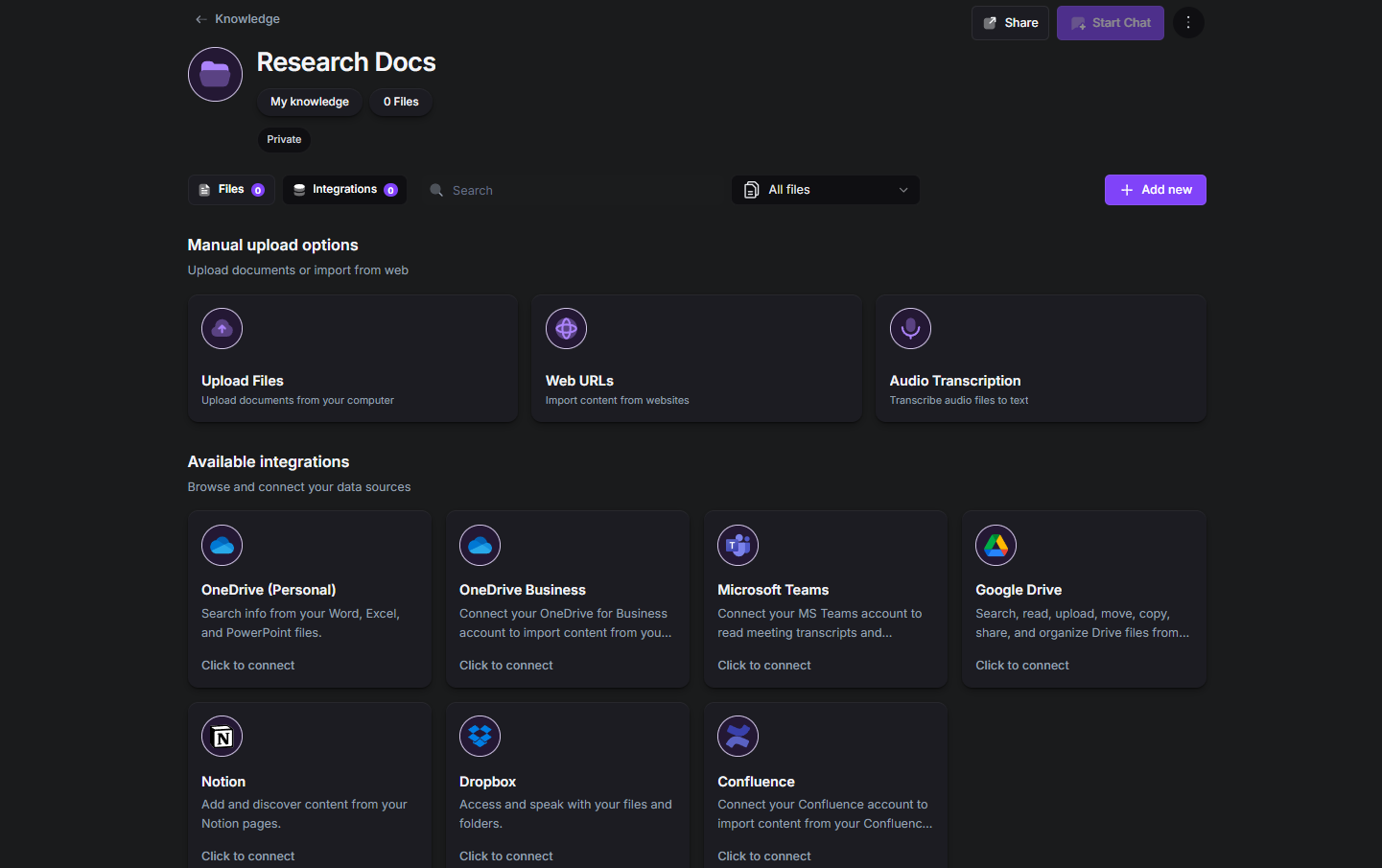
TextCortex knowledge bases allow you to analyze the databases you upload or connect to, turning your raw data into insightful information. You can upload documents manually to TextCortex or connect databases like Google Drive, OneDrive, Slack, and Notion with a single click. Afterward, you can automate a wide range of data-related tasks, from target identification to dataset processing, saving you time. For example, Atares saves up to 20 hours per employee per week by automating data-related tasks and enhancing knowledge management with TextCortex.
Market Research and Web Access
TextCortex web access allows you to automate tasks requiring real-time online data, such as market mapping, cold outreach, and market monitoring. By combining both internet data and your own data, TextCortex processes even the smallest details that might otherwise escape human attention, maximizing your research quality.
Custom Workflow Automations
TextCortex shines with its highly customizable automation capabilities. With TextCortex, you can automate a wide range of deal sourcing tasks, from simple tasks like cold outreach email/message writing to complex tasks with multiple steps, such as data enrichment. TextCortex already offers AI agents optimized for different tasks. However, with the TextCortex AI agent framework, you can build AI agents that you can customize for your specific tasks, from the default large language model to databases. You can complete the entire process manually or using our AI-powered agent builder.
Domande frequenti
How does generative AI speed up due diligence?
Generative AI accelerates due diligence by automating repetitive or complex tasks and helping you complete tasks such as data analysis, document analysis, and market research.
How accurate is AI in M&A due diligence?
Generative AI is highly accurate when it comes to processing and synthesizing large volume of data and documentation.
How much time does AI save in M&A?
The time savings that Generative AI provides in M&A depend entirely on how intensively you use it and how well you implement it in your enterprise. For example, Atares saves up to 20 hours of time per user per week with TextCortex AI.
.png)
.png)
.png)