.png)
The EU AI Act becomes fully applicable in August 2026, meaning enterprises have a limited time to evaluate vendors. Many AI tools are not yet EU AI Act compliant, presenting legal and deployment challenges for businesses. You need to make your existing AI tools EU AI Act compliant by August 2026. Alternatively, you can consider alternative AI platforms that are EU AI Act and GDPR compliant. If you're curious about EU AI Act requirements or want to learn about EU-hosted AI platforms you can use, we've got you covered.
In this article, we will explore what the EU AI Act is and its importance for enterprises.
TL; DR
The EU AI Act takes full effect in August 2026, imposing penalties up to €35 million or 7% of global turnover for non-compliance. It applies to providers, deployers, importers, and distributors of AI systems, categorizing them into four risk levels—minimal, limited, high-risk, and prohibited with enterprises typically falling into the high-risk tier for HR, finance, and critical infrastructure use. Prohibited practices include social scoring, emotion recognition, and manipulative AI. A six-point compliance checklist covers: risk classification, data governance (GDPR-compliant sourcing and lineage), logging and auditing, human oversight with override capability, transparency and documentation, and EU data residency to avoid US surveillance law conflicts. ChatGPT is not EU AI Act compliant by default, but can be accessed as compliant through EU-hosted providers. TextCortex offers a ready-made solution, delivering frontier models (GPT-5.5, Claude Opus 4.7, Gemini 3.1 Pro) and budget alternatives (GLM 5.1, DeepSeek V4 Pro) as EU-hosted, GDPR-compliant APIs with built-in AI agents, skills, connectors, and enterprise automation features.
Was ist der EU AI Act?
The EU AI Act is a legal framework for artificial intelligence enacted by the European Union and entering into force in a phased rollout. It categorises AI systems by their potential risks to society. The EU AI Act creates rules for general-purpose and enterprise-purpose artificial intelligence models. Failure to apply the EU AI Act to the AI models you use may result in penalties of EUR 7.5 million or 1.5% of worldwide annual turnover to EUR 35 million or 7% of worldwide annual turnover.
Who Does the EU AI Act Apply to?
The EU AI Act applies to multiple operators in the AI value chain, such as providers, deployers, importers, distributors, product manufacturers, and authorized representatives. To briefly list those covered by the EU AI Act, being a service provider is sufficient; the final buyer is not affected. If you use AI for monetization purposes, you are subject to the EU AI Act. Let's take a quick look at the list of those covered by the EU AI Act:
- Providers: Providers are people or organizations that develop AI systems or have them developed on their behalf and place them on the market under their name or trademark.
- Deployers: Deployers are people or organizations that use AI systems, for example, organizations or enterprises that use AI agents to automate their workflows.
- Importers: Importers are people or organizations located or established in the EU that bring AI systems or models of a company established outside of the EU.
- Distributors: Distributors are people or organizations that distribute AI models developed outside the EU in the EU market.
What the EU AI Act Requires?
The EU AI Act categorizes AI models into four different risk categories. Risk levels refer to the likelihood and severity of the potential harm. The risk levels defined by the EU AI Act include:
Minimal Risk: AI Chatbots and Spam Filters
Limited Risk: Transparency Obligations
High-Risk: AI in HR, Finance, Healthcare, and Critical Infrastructure (Here is the level for which enterprises are mostly responsible)
Unacceptable Risk: Prohibited Practices
Prohibited AI Practices
The EU AI Act explicitly lists certain prohibited AI practices that are deemed to pose an unacceptable level of risk. For example, fine-tuning and developing AI models to manipulate people's preferences, opinions, or purchases is one of the prohibited AI practices. Providing false information to persuade a user to buy a particular brand or service is also prohibited. The partial list of prohibited AI practices at the time this article was published includes:
- Social scoring systems
- Emotion recognition systems
- AI used to exploit people’s vulnerabilities
- Untargeted scraping of facial images
- Biometric identification systems
- Law enforcement of real-time remote biometric identification systems in public
The Enterprise EU AI Act Checklist
If you are fine-tuning AI models for your enterprise, or looking for AI models to use in your enterprise, applying the following checklist will be helpful.
1. Risk Classification
The first thing you should check and tick is whether the vendor or provider complies with the EU AI Act risk levels. If the AI tool you will be using is at Level 3 of the EU AI Act, such as AI for finance or HR, verify that the vendor or provider complies with the EU AI Act regulations.
2. Data Governance
The second thing you need to check is where the vendor or provider stores the data. Here, you need to ask the vendor or provider a few questions:
- Where is the training data sourced?
- Is it GDPR-compliant?
- Can you audit data lineage?
Based on the answers to these questions, you can understand whether the AI model is EU AI Act compliant. Since the EU AI Act protects not only generative AI output but also everything from training data to the storage of customer data.
3. Logging and Auditing
EU AI Act requires high-risk AI systems to automatically log inputs, outputs and events while operating. These logs must be maintained for a period appropriate to the system's purpose, and deployers must be able to reconstruct the decision trail. For this reason, you need to make sure that the vendor or provider offers logging, monitoring and auditing systems. Here are a few questions you can ask the vendor or provider:
- Do you maintain automatic logs of all inputs, outputs and system events?
- What is the log retention period?
- Where are logs stored?
4. Human Oversight
EU AI Act requires high-risk AI systems to be designed for effective human oversight. Natural persons must be able to:
- understand system capabilities and limitations
- correctly interpret outputs
- decide not to use the system in particular situations
- intervene in the operation of the system
Questions you can ask the vendor or provider:
- What human-in-the-loop mechanisms are built into the system?
- Can a human operator override, reverse, or disregard an AI output?
- Is there training documentation for human overseers?
5. Transparency & Documentation
EU AI Act requires that AI systems be accompanied by instructions for use, including: intended purpose, limitations, performance characteristics, known risks, and foreseeable misuse scenarios. Additionally, the EU AI Act requires users to provide transparent and honest information when interacting with AI.
Questions you can ask the vendor or provider:
- Do you provide clear documentation on intended purpose, limitations, and known failure modes?
- Is there a model card or system card with performance metrics?
- For chatbot or assistant use, is AI-generated content declared to end users?
6. EU Data Residency
While the EU AI Act does not explicitly mandate EU hosting, GDPR rulings effectively require that personal data processing not be subject to US surveillance laws. For high-risk AI systems processing personal data, EU data residency is the only practical way to satisfy both the AI Act and GDPR simultaneously.
TextCortex: EU AI Act Compliance AI Solution
If you want to integrate an EU AI Act and GDPR compliant AI system into your enterprise, TextCortex is the solution for you. TextCortex is an LLM provider and enterprise AI solution that meets all EU AI Act requirements, stores and protects your data on EU-hosted servers, and offers frontier AI models in an EU AI Act-compliant manner.
Use Frontier Models as EU-Hosted
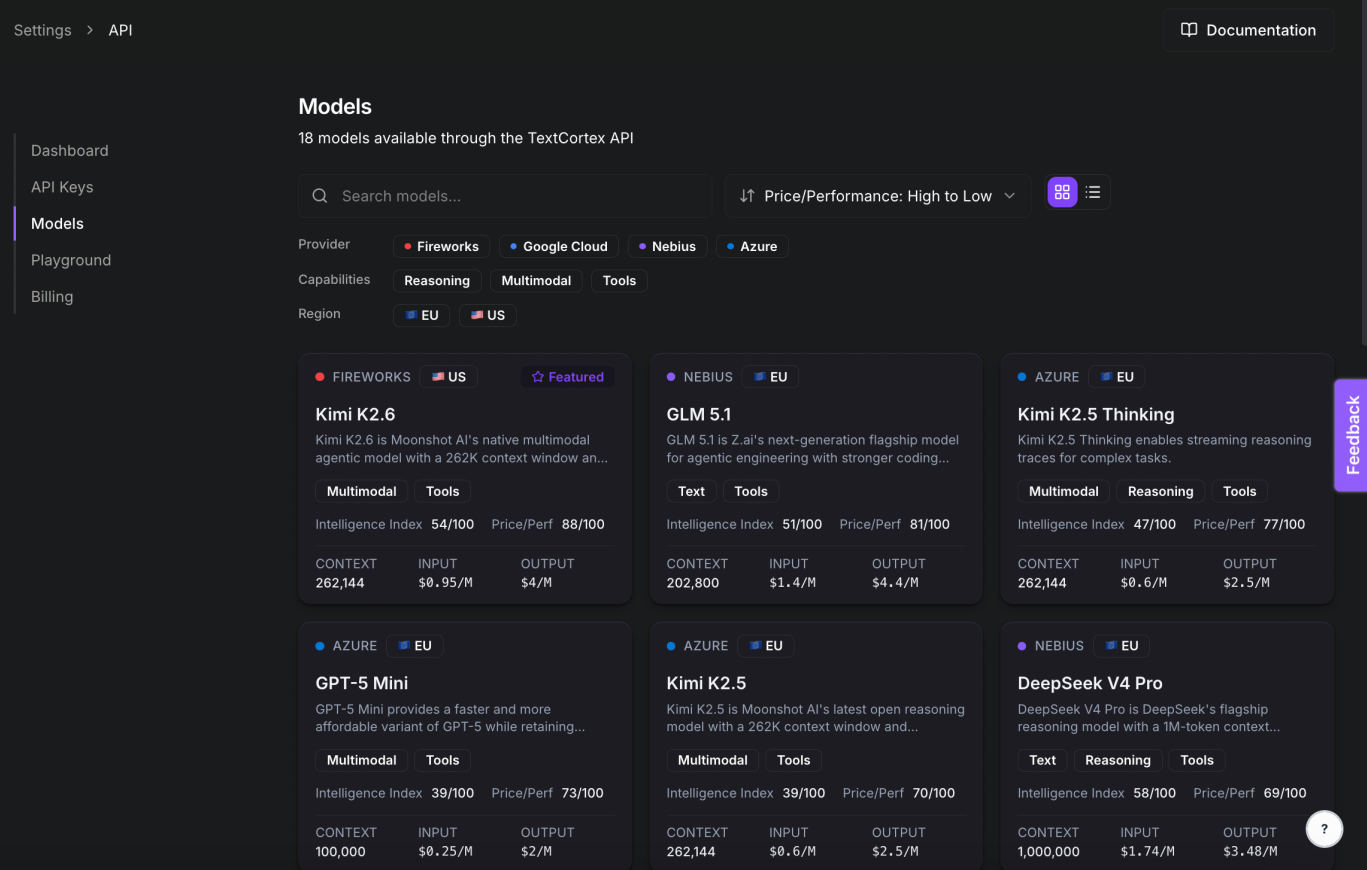
With TextCortex, you can integrate state-of-the-art and advanced frontier models like GPT-5.5, GPT-5.4, Claude Opus 4.7, Claude Sonnet 4.6, and Gemini Pro 3.1 into your enterprise workflow as EU-hosted and EU AI Act Compliant. TextCortex offers frontier models and more budget-friendly performance alternatives like GLM 5.1 and DeepSeek V4 Pro as EU-hosted via a single API.
AI Agents and Enterprise Features
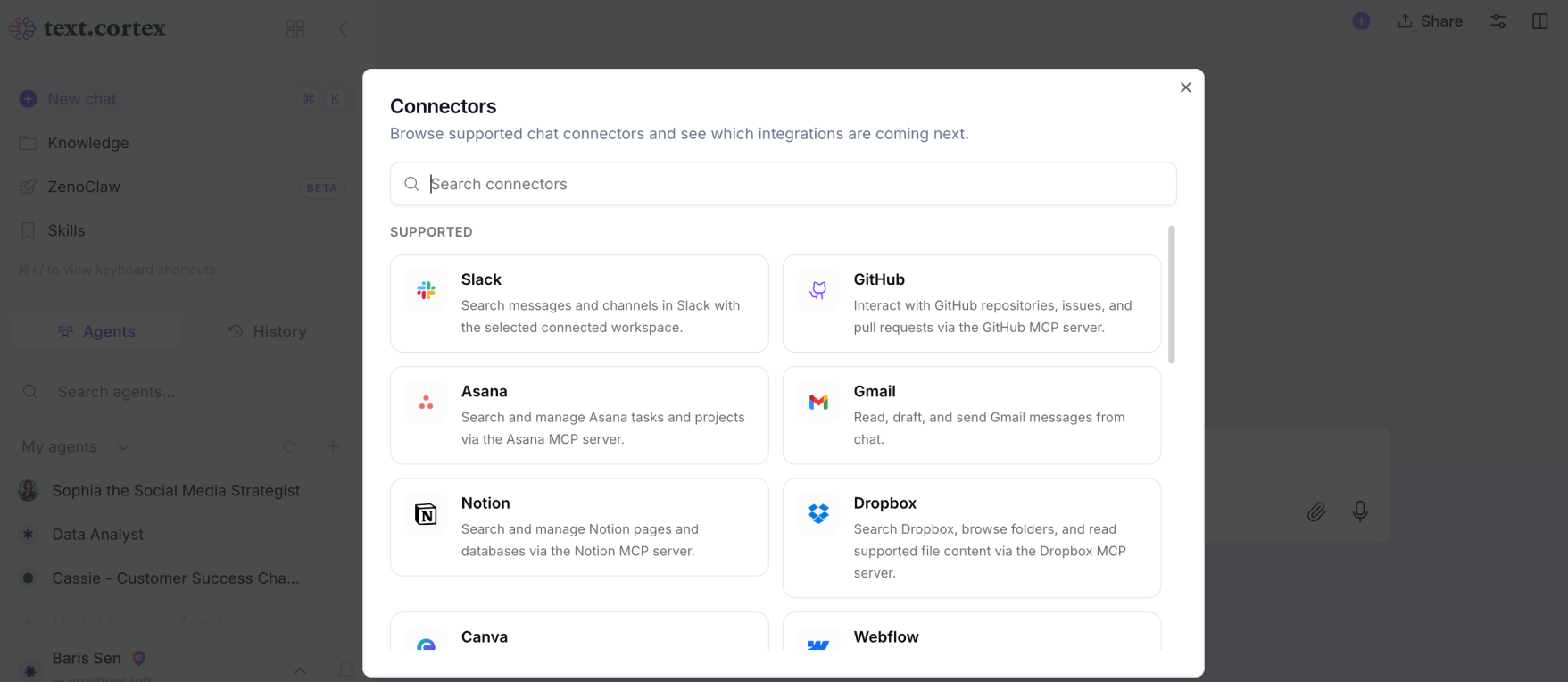
If you want to automate your enterprise's workflow or enhance your knowledge management, TextCortex is the solution you're looking for. TextCortex comes with an AI agent framework, skills, and connectors that you can customize for specific tasks. With the AI agent framework, you can build automations for specific tasks or departments; with skills, you can add use-case-focused features to your agents; and with connectors, you can enable your agents to access the apps they need.
Häufig gestellte Fragen
What are the EU AI Act penalties for non-compliance?
Failure to apply the EU AI Act to your AI models may result in penalties ranging from EUR 7.5 million or 1.5% of worldwide annual turnover to EUR 35 million or 7% of worldwide annual turnover.
Is ChatGPT EU AI Act compliant?
No, ChatGPT's free tier doesn't offer EU AU Act compliance, even in its paid tiers. However, you can access ChatGPT models as EU-hosted and EU AU Act compliant via TextCortex.
What does the EU AI Act require of AI vendors?
The EU AI Act requires AI vendors to classify their systems by risk level (minimal, limited, high-risk, or prohibited), maintain risk management and data governance systems, provide conformity documentation for high-risk AI, ensure human oversight, and maintain automatic audit logs.
.png)
.png)
.png)