.png)
Moonshot AI released Kimi K2.7 Code on June 12, 2026, the latest MoE-based open-source coding model. Kimi K2.7 Code is built with the same 1 trillion parameter architecture as the K2.5 and K2.6 models. One of the main focuses of Kimi K2.7 Code is to do more work while consuming fewer tokens. As a result, just like the Claude Sonnet 5 model, Kimi K2.7 Code delivers the same performance as its predecessor using 30% fewer tokens. If you're wondering what Kimi K2.7 Code is and what it offers, we've got you covered!
In this article, we will examine the Kimi K2.7 Code model and explore its features.
TL; DR
Moonshot AI released Kimi K2.7 Code on June 12, 2026, a 1-trillion-parameter MoE coding model with 32 billion active parameters per token. It is optimized for long-horizon coding, end-to-end software engineering, and multi-file tasks, featuring a 256K context window, always-on thinking mode, and multimodal inputs (text, code, image, video). Compared to its predecessor, it delivers 30% better token efficiency, lowering overall costs for agentic coding workflows. API pricing is $0.19 per million input tokens and $4 per million output tokens for the standard model, or $0.38/$8 for the high-speed variant. Premium chat access starts at $19/month via Moonshot AI's Moderato plan. Benchmarks show strong gains over K2.6, though it still trails GPT-5.5 and Claude Opus 4.8 slightly. Kimi K2.7 Code is not GDPR/EU AI Act compliant by default, but TextCortex offers it as a compliant EU-hosted API and as the default LLM for custom AI agents.
What is the Kimi K2.7 Code?
Kimi K2.7 Code is a coding-focused, large-scale language model developed by Moonshot AI Studio and released on June 12, 2026. Kimi K2.7 Code uses a Mixture-of-Experts (MoE) architecture with 1 trillion total parameters and 32 billion active parameters per token. The "Code" in the model's name indicates that it is fully optimized for long-horizon coding and reasoning tasks. With Kimi K2.7 Code, you can complete complex debugging sessions, end-to-end software engineering workflows, and multi-file coding tasks.
Kimi K2.7 Code Features
Kimi K2.7 Code model is an open-source large language model developed by Moonshot AI Studio and focused on coding tasks. Kimi K2.7 Code model comes with:
- Kimi K2.7: The latest and most advanced member of the Kimi K2 series.
- KimiCode: A coding-focused model powered by K2.7.
- 256K Context Window: Sufficient input and output capacity for long files and databases.
- Thinking: The model uses thinking mode enabled by default.
Kimi K2.7 Code Pricing
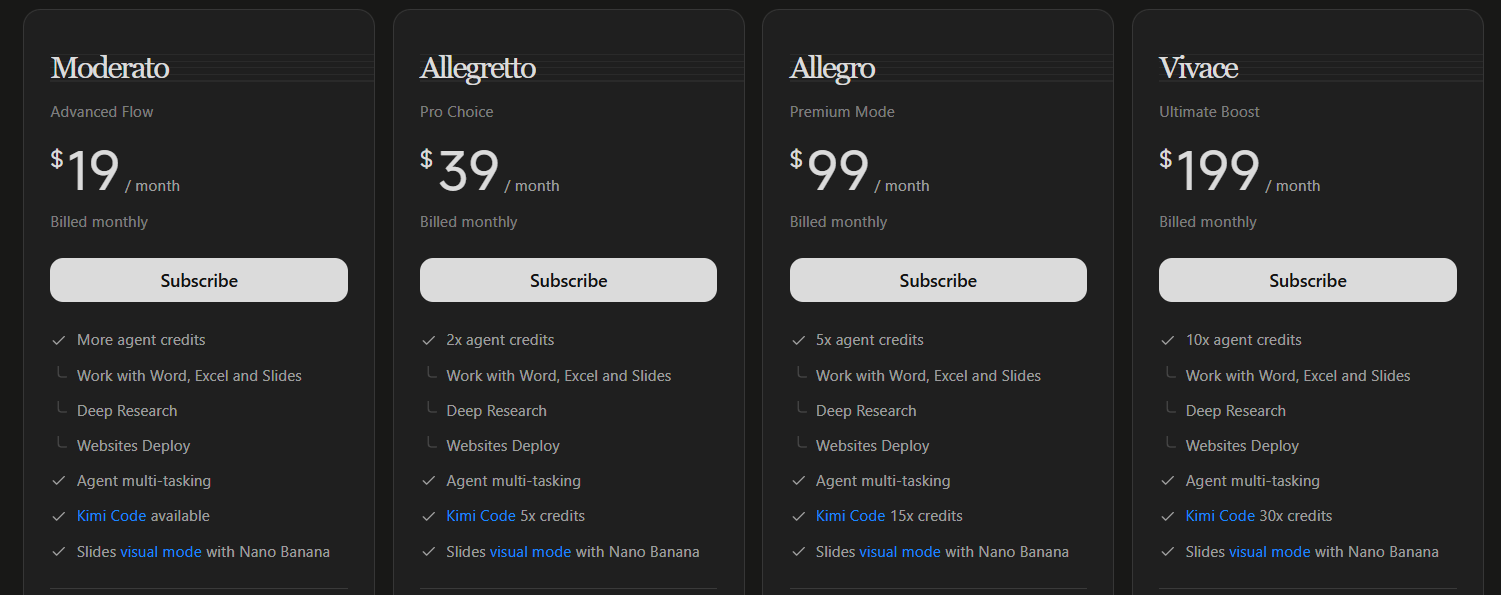
You can access the Kimi K2.7 Code model with one of the Moonshot AI premium subscription plans. The cheapest of the premium Moonshot AI plans that provides access to KimiCode is the Moderato plan, at $19 per month.
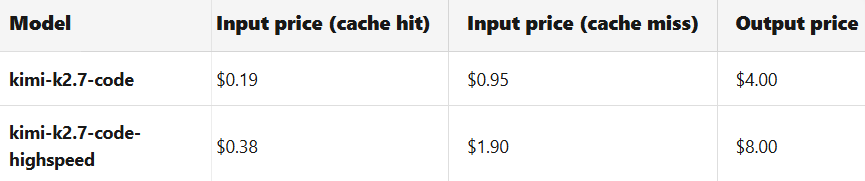
If you want to use the Kimi K2.7 Code model as an API, you have two options:
- Kimi-k2.7-code: $0.19 per million input tokens and $4 per million output tokens
- Kimi-k2.7-code-highspeed: $0.38 per million input tokens and $8 per million output tokens
Kimi K2.7 Code Performance and Upgrades
The Kimi K2.7 Code model comes with significantly improved agentic, coding, and reasoning capabilities compared to its predecessor. If you're curious about the model's performance and what new features it offers, we've prepared a list for you.
Kimi K2.7 Code Benchmark Performance
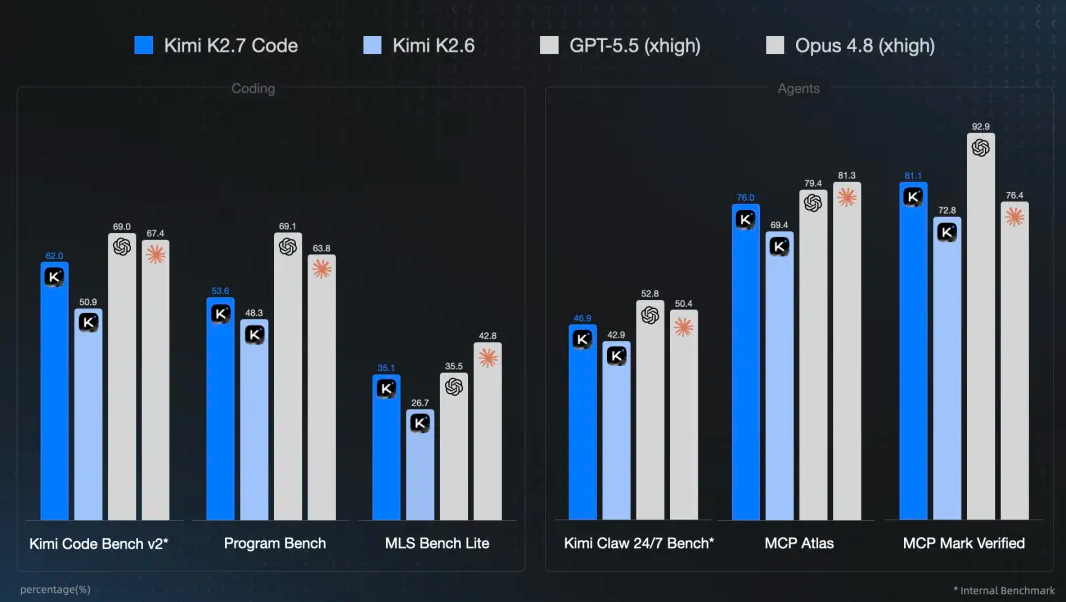
The Kimi K2.7 Code model demonstrates significantly better coding, reasoning, and agentic performance compared to the selfie K2.6 model. However, when comparing GPT-5.5, Claude Opus 4.8, and K2.7 Code, the Kimi K2.7 Code model lags slightly behind the other two frontier models.
Long Context Coding
The Kimi K2.7 Code model comes with a 256K context window, which means it can process large amounts of data and generate longer outputs. This is important because programming tasks often involve several different files, project structures, framework rules, test outputs, logs, and user constraints. To handle such large amounts of data as input, the model needs a large context window.
Thinking Mode is Always On
The Kimi K2.7 code model comes with thinking mode enabled by default. It also does not support disabling thinking mode. While this may not seem like a very logical choice for everyday use, when it comes to coding, the planning, verification, detailed examination, elaboration, and recovery from failed attempts features offered by thinking mode make things easier.
Multimodal Inputs
The Kimi K2.7 Code model supports text, code, image, and video inputs. The model's support for multimodal inputs is functional in several case studies, for example:
- It can convert screenshots into front-end components.
- It can analyze product mockups.
- It can debug the UI from screen recordings or screenshots.
- It can explain errors in screenshots.
- It can complete visual requirements with code.
- It can code your final product plan based on visuals.
Token Efficiency
The most practical improvement of the Kimi K2.7 Code model is the 30% token efficiency. Compared to its predecessor, the K2.7 Code model reduces your overall token expenditure and cost by spending 30% fewer tokens while performing the same tasks. Since K2 models were developed for autonomous and agentic tasks, a 30% reduction in token expenditure means lower costs for autonomous tasks. If you are currently using the Kimi K2.6 model, switching to the K2.7 Code model will reduce your token expenditure and therefore your overall cost. This optimization allows you to use the K2.7 Code model to automate more tasks or allocate additional budget to departments like marketing.
TextCortex AI: Access Kimi K2.7 Code as GDPR-Compliant
TextCortex is a leading knowledge management and workflow automation platform that aims to reduce the workload of enterprises by providing them with an AI agent framework, GDPR-compliant LLMs, knowledge bases, web search, and much more. If you want to integrate a wide range of LLMs, including Kimi K2.7 Code, into your enterprise or automate your workflows using them to save time, TextCortex is the solution you're looking for.
Use Kimi K2.7 Code in Europe
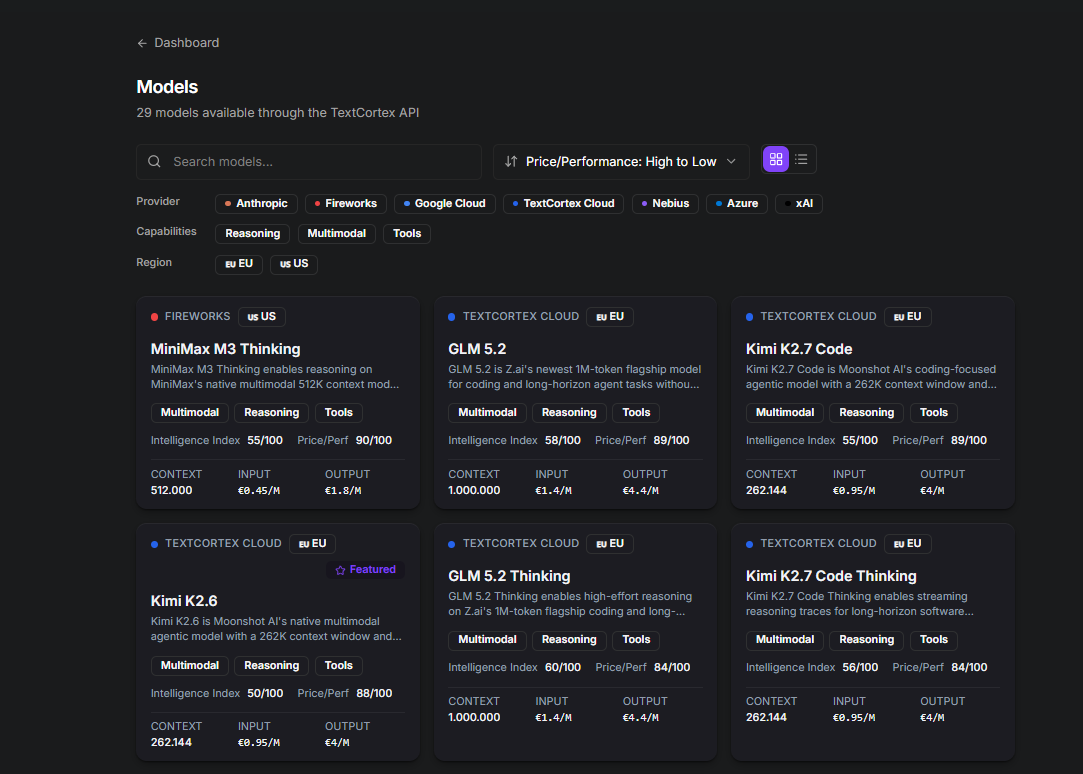
To use AI models in the European region, you need to use regulation-compliant models, and most models, including the Kimi K2.7 Code, are not compliant by default. With TextCortex, you can use a wide range of LLMs, including the Kimi K2.7 Code, as GDPR and EU AI Act-compliant APIs. The TextCortex API gives you access to dozens of different frontier and advanced large language models, which you can use in your enterprise or your own AI app.
Kimi K2.7 Code Powered AI Agents
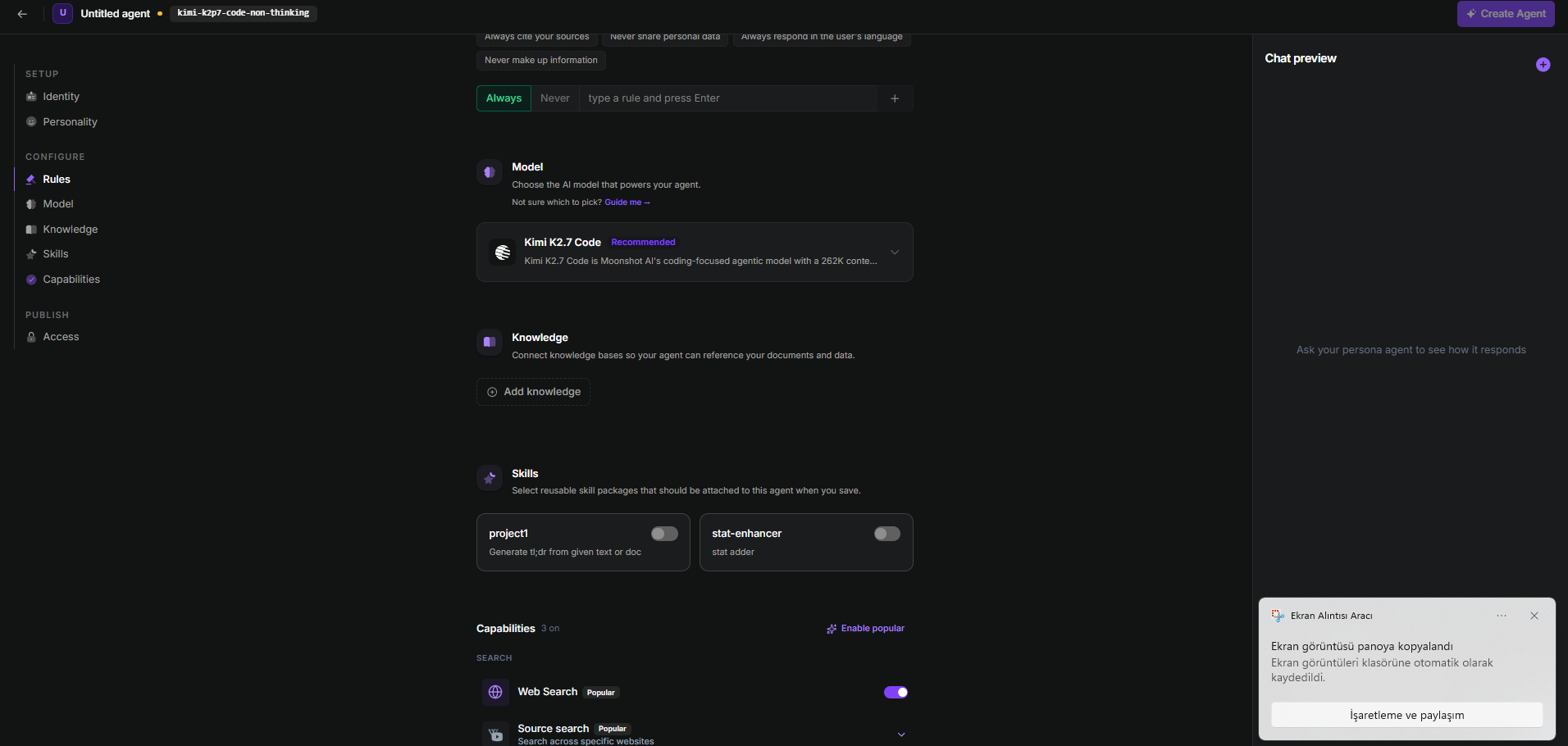
TextCortex comes with a detailed AI agent builder that allows you to select the Kimi K2.7 Code model as the default LLM. If you want to build Kimi K2.7 Code-powered AI agents to assist you with your coding and engineering tasks or to automate your workflows, TextCortex is the solution for you. To build a Kimi K2.7 Code-powered AI agent with TextCortex, all you need to do is head to the TextCortex web app and click the "create agent" icon in the left-hand menu. After that, you can build your AI agent manually or automatically with AI assistance, and you can select the Kimi K2.7 Code model as the default model during the build process.
よくある質問
Is Kimi K2.7 good?
The Kimi K2.7 Code model is an effective and good LLM in areas such as coding, reasoning, and agentic workflow automation.
How cheap is Kimi K2.7?
Compared to frontier models that are alternatives to the Kimi K2.7 model, such as the GPT-5.5, the Claude Opus 4.8 is a much more affordable model with significantly lower API pricing.
Which country made Kimi K2.7?
The Kimi K2.7 Code models were developed by Moonshot AI Studio, a Chinese company.
.png)
.png)
.png)