.png)
In the new era of AI technology, one of the critical points is where AI platforms store data and who controls the movement of that data. Sovereign AI is the fundamental method of controlling who controls the data, how the data can be used, and what caliber of data models can access it. In other words, sovereign AI is not just intelligence, but intelligence management and control. If you are curious about sovereign AI and its impact on your enterprise, keep reading!
TL; DR
Sovereign AI is the end-to-end control of your AI stack, data, models, infrastructure, and governance, to ensure compliance, security, and transparency. It goes beyond data sovereignty by covering five layers: who accesses your data (data sovereignty), where hardware runs under which laws (infrastructure), model choice and version control (model), oversight of training and bias (lifecycle governance), and independence from vendor roadmaps (operational). Key benefits include stronger protection of sensitive data, increased customer trust, regulatory adherence, and minimized third-party risk. Achieving it involves defining objectives, segmenting data by sensitivity, building or leasing compliant infrastructure, integrating trusted platforms, and continuous monitoring. For most enterprises, owning the entire stack is impractical; instead, EU-hosted providers like TextCortex offer a ready-made path, delivering 18+ frontier and budget LLMs (including GPT-5.5, Claude Opus 4.7, and GLM 5.1) as GDPR and EU AI Act compliant via a single API, with built-in monitoring, auditing, and enterprise connectors.
¿Qué es la IA Soberana?
Sovereign AI, in its simplest terms, is domestic protection and control against the potential dangers of AI. This protection includes the level of access to user data, not using user data for model training, avoiding harmful output generation, and providing a transparent output generation process. Any enterprise must optimize its AI models according to regulations and regional laws before integrating them into its workflows. For example, if you are a company that wants to use AI in the European region, the AI model you use must be compliant with the EU AI Act and GDPR.
Why is Sovereign AI Important?
Sovereign AI is important because it can lead organizations to ensure that only authorized users have access to data, to protect important and sensitive data more effectively, and to safeguard company data. Sovereign AI aims to protect not only company customers but also enterprises through data security and transparency, and it acts as a security layer to prevent potential data leaks.
Advantages of Implementing Sovereign AI into Your Business
Sovereign AI provides an extra layer of security for enterprises, along with several other advantages:
- Implementing sovereign AI may help organizations do a better job of protecting applications, sensitive data, and infrastructure.
- In addition to data security, implementing sovereign AI increases customer trust in the enterprise and brand by offering users a transparent process.
- Sovereign AI strengthens customer security, increasing your potential customer base.
- By integrating sovereign AI into your enterprise, you can ensure adherence to strict local data residency laws such as GDPR.
- You can control AI models in detail, such as managing model parameters.
- Thanks to sovereign AI, you can minimize third-party risks and build a liability firewall.
Sovereign AI vs. Data Sovereignty: What’s the Difference?
Data sovereignty refers to legal jurisdiction over data, while sovereign AI refers to control over the entire AI stack, including data, models, infrastructure, and governance. With sovereign AI, you can have complete control over AI models, fully manage their infrastructure, control data flow, fine-tune the model to your needs, and build an extra layer of security.
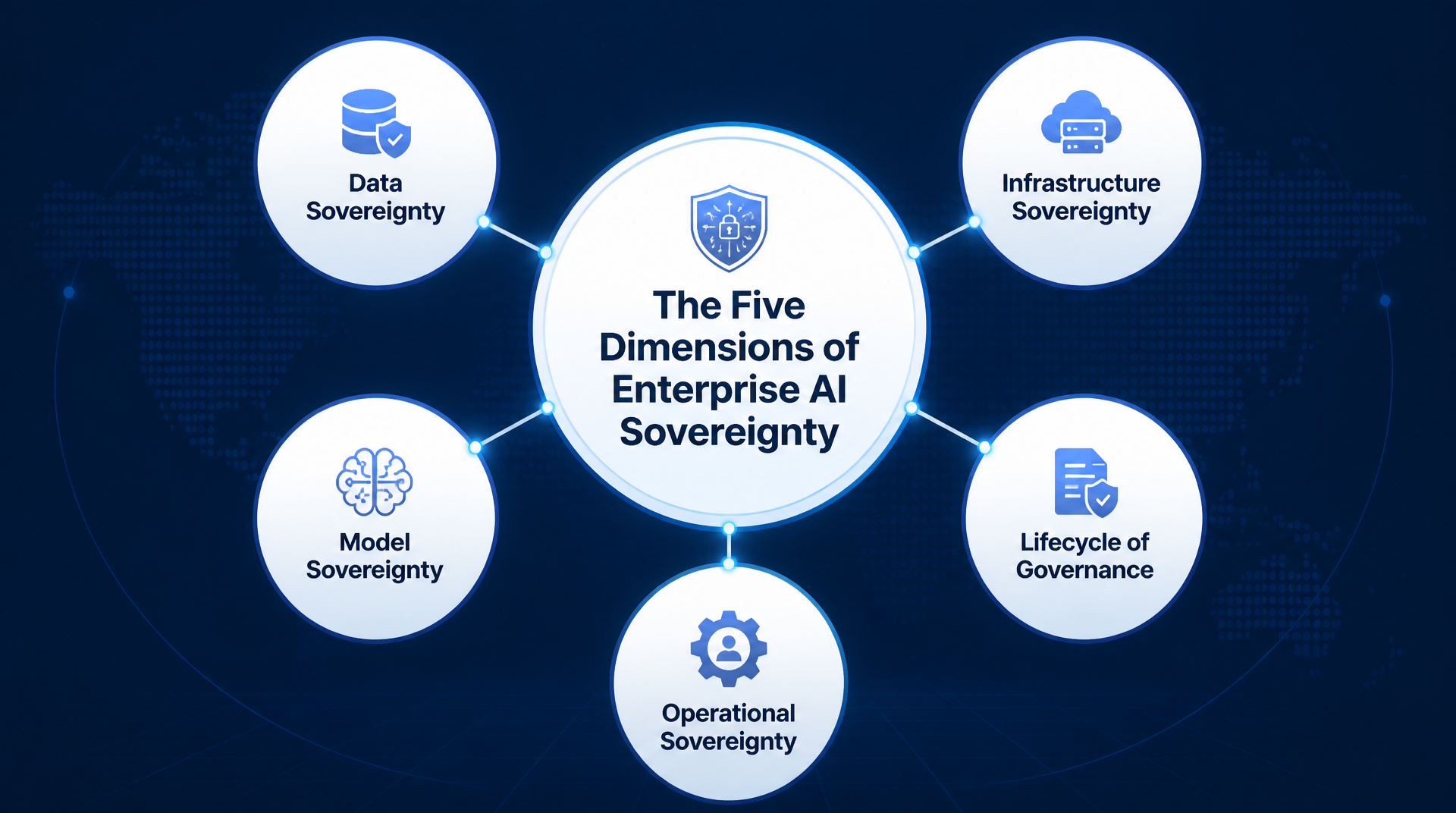
The Five Dimension of Enterprise AI Sovereignty
Sovereign AI is not a single button you press; it includes a stack of control layers that together help you control AI. Sovereign AI essentially comprises five different layers:
- Data sovereignty: This layer defines who can access your training data, user inputs, model outputs, and other internal data, and under what conditions this data can be stored.
- Infrastructure Sovereignty: This means that components such as cloud provider, network paths, and GPU cluster ownership are deployed in the EU and run under EU law.
- Model Sovereignty: This layer demonstrates which AI model your enterprise uses, whether it's fine-tuned according to regulations, whether it can freeze the model version for stability, and whether it can deploy the model instead of just providing API access. This layer aims to ensure you have complete control over AI models, rather than leaving them entirely to the provider's discretion.
- Lifecycle of Governance: Lifecycle governance covers everything that happens before and after inference: how training data was sourced, whether bias was measured and mitigated, and whether humans retain meaningful oversight over high-stakes decisions.
- Operational Sovereignty: This layer allows you to be independent and have full control over the operational process of AI models without being dependent on the vendor's initiative.
How to Achieve Sovereign AI Infrastructure?
Implementing sovereign AI is not a hard task if you follow the systematic strategy.
Step 1: Define Sovereignty Objectives
Identify and define the objectives required for your sovereign AI infrastructure. In this process, list what AI means to your organization, the areas where you use AI, and the data you process with AI. Then, document the laws and regulations you must comply with for your AI usage.
Step 2: Segment Data
Classify your data by sensitivity level and by the regulations that govern it. Identify where each type of data is held and find what controls and access you need to maintain full control over data. Group data by classification level and apply controls to match level. High-sensitivity data needs strict residency controls and stronger security layers.
Step 3: Build Infrastructure
Instead of building infrastructure from scratch, you can have a space where you can deploy and run the model using infrastructure tools. Using infrastructure tools, you can specify residency constraints, allowed regions, identity policies, approved container registries, network isolation rules, and data classification boundaries. At this stage, you can choose platforms that support multi-cloud and hybrid deployments.
Step 4: Integrate Trusted AI Platforms
Once you set up your infrastructure, you should integrate AI platforms that support sovereignty and allow you to develop and run AI models. Prioritize platforms built on open-weight LLMs to avoid vendor lock-in.
Step 5: Establish Continuous Monitoring and Auditing
One of the most critical aspects of Sovereign AI is its monitoring and auditing section, where you can continuously monitor models, outputs, suspicious inputs, and the health of the AI. Set up monitoring and auditing systems to increase the visibility of your AI operations and maintain control at all times.
The Enterprise Reality: You Don’t Need to Own Everything
Achieving sovereign AI can be a costly and time-consuming undertaking for small and medium-sized organizations. Therefore, instead of building sovereign AI for your enterprise, you can leverage existing platforms that offer this service. When researching platforms offering sovereign AI services, prioritize EU-hosted AI providers that offer model diversity and full control. These platforms ensure that the AI models you implement in your enterprise are GDPR and EU AI Act compliant, allowing you to bypass the heavy lifting and integrate the AI system directly into your enterprise. For example, TextCortex allows you to integrate frontier models like OpenAI, Claude, and Gemini into your enterprise as EU-hosted and GDPR-compliant systems.
TextCortex AI: EU-Hosted AI Model Provider
If you want to integrate EU-hosted sovereign AI into your enterprise, TextCortex is the AI gateway you're looking for. TextCortex is an EU-hosted AI model provider that offers frontier models like ChatGPT, Gemini, and Claude as EU AI Act and GDPR-compliant. With TextCortex AI, you can deploy frontier models like GPT-5.4, GPT-5.5, and Claude Opus 4.7 as GDPR-compliant to your enterprise. Thanks to the TextCortex API, you can use a total of 18 powerful and frontier large language models, including ChatGPT models, as EU-hosted and integrate them into your own AI models via a single API. TextCortex also offers users a wide range of connectors that they can directly integrate with, such as Slack, Notion, Confluence, SharePoint, and GitHub.
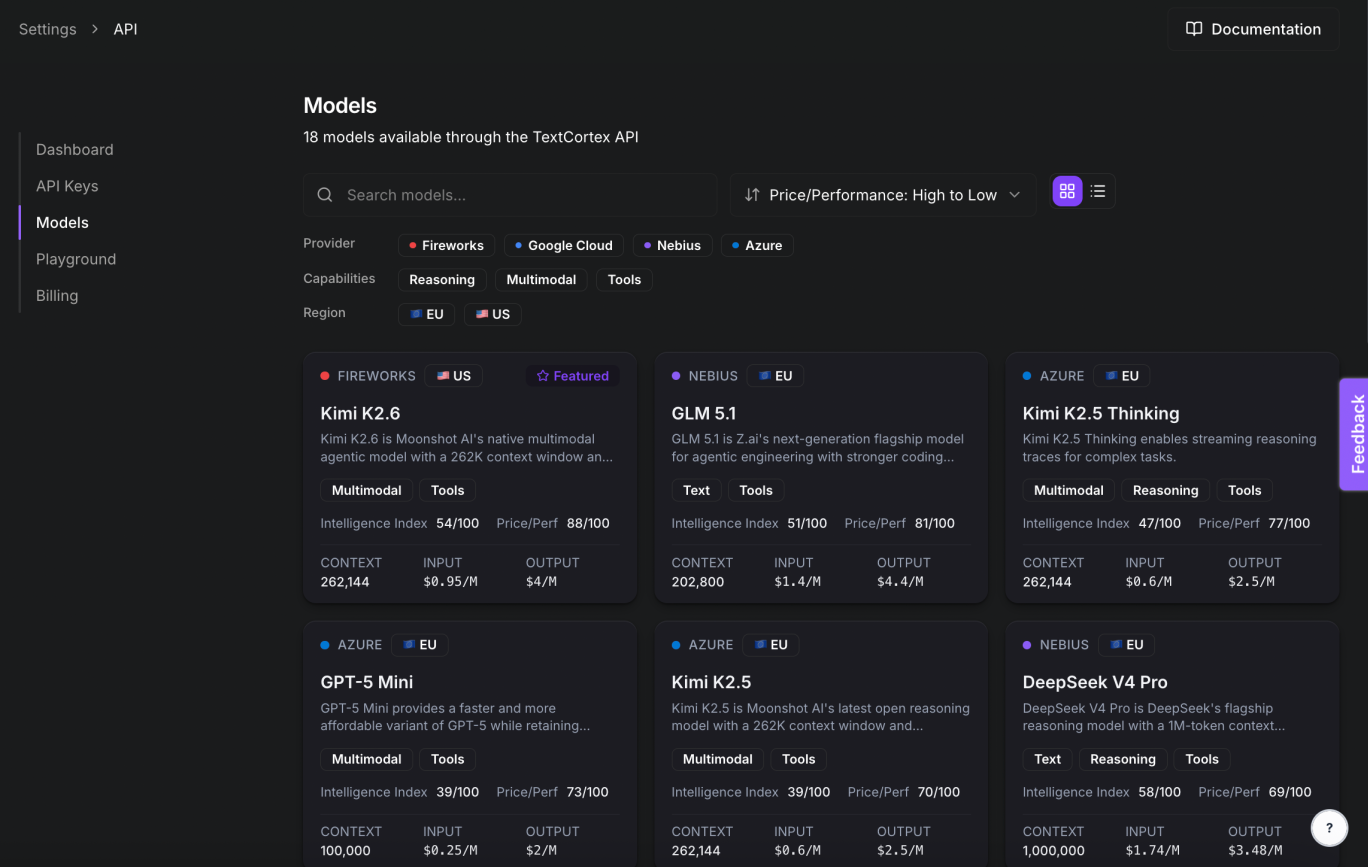
TextCortex allows you to quickly and easily integrate frontier large language models, such as GPT-5.5 and Claude Opus 4.7, as well as alternative, affordable LLMs such as GLM 5.1, into your enterprise. TextCortex offers all its models as EU-hosted and sovereign. This means you don't have to deal with any build and complex deployment processes when using TextCortex models in your enterprise. Furthermore, TextCortex provides users with continuous monitoring and auditing, allowing you to track the health and security of your AI systems simultaneously.
Preguntas frecuentes
Is ChatGPT GDPR compliant?
No, ChatGPT is not GDPR-compliant by default in its free and even paid subscriptions. To use ChatGPT as GDPR-compliant, you need to modify it. An alternative method is to use ChatGPT models as EU-hosted and GDPR-compliant via TextCortex.
Do AI vendors need to be EU-headquartered for sovereignty?
No, AI vendors do not legally have to be EU-headquartered to do business in Europe.
Can I run Claude or GPT in the EU?
Yes, you can run the Claude and GPT models in the EU and use them for personal purposes. However, if you want to leverage the Claude and GPT models for commercial use, you need to make them EU AI Act and GDPR-compliant. Alternatively, you can use the Claude and GPT models for commercial use via TextCortex as GDPR-compliant and EU-hosted.
.png)
.png)
.png)